


The installation of the WJ-8 railway fastener system requires precise operation to ensure that all components are installed in place to ensure the stability and safety of the high-speed railway track. The following are key precautions during the installation process.
Pre-installation preparation points
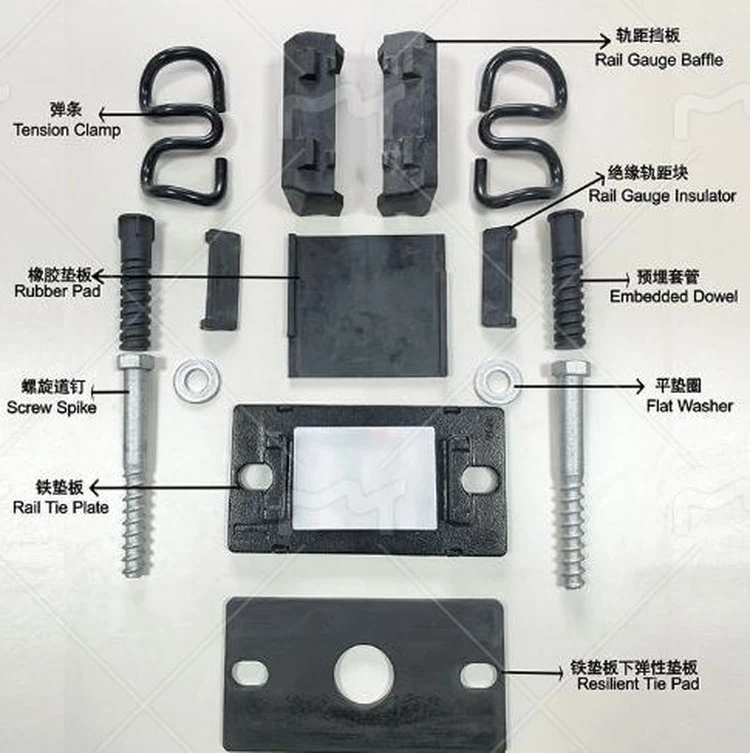
Before installation, all components must be fully inspected. Carefully check whether there are cracks, deformation, rust and other defects in the spiral spikes, spring bars, gauge baffles and other components to ensure that their quality meets the standards. For example, if the spring bar has a tiny crack, it may break due to force during use, affecting the buckling pressure of the fastener system. At the same time, it is necessary to check whether the component model is consistent with the design requirements. Different models of gauge baffles and spring bars are suitable for different installation scenarios and resistance requirements. If the model is wrong, the gauge adjustment or line resistance will not meet the requirements. In addition, it is necessary to clean the debris in the embedded casing to ensure that the inner wall of the casing is clean, otherwise it will affect the screw-in depth and fastening effect of the spiral spike.
Key points in the installation process
When installing spiral spikes, special tools should be used to ensure that the spikes are screwed vertically into the embedded casing to avoid uneven force due to tilting. The tightening torque must be strictly implemented in accordance with the standard. Excessive torque may damage the casing or spikes, and too little torque cannot provide sufficient tightening force. Generally speaking, the tightening torque of S2 and S3 spiral spikes should be controlled within the specified range to ensure that the spring clips obtain appropriate buckle pressure.
Points for inspection after installation
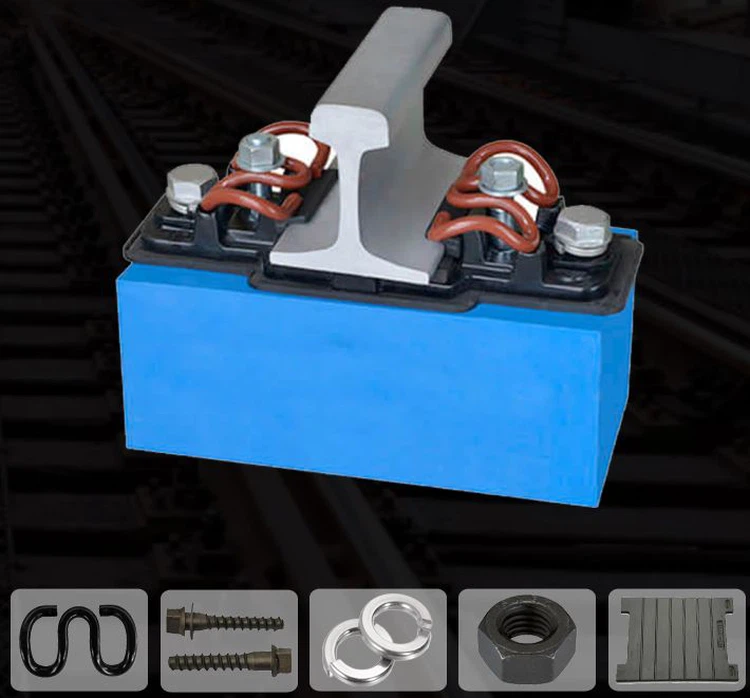
After installation, the entire fastener system needs to be fully inspected. Confirm again whether the tightening torque of all bolts meets the standard and whether the buckle pressure of the spring clip meets the requirements. The buckle pressure can be detected by observing the deformation of the spring clip and using special tools. Check whether the track gauge is accurate, whether the rail pad and elastic pad are in the correct position, and whether there are signs of looseness or displacement. At the same time, the insulation performance of the fastener system should be checked to ensure that the insulating gauge block and other insulating components are intact to prevent safety hazards such as leakage.
Only by following the above installation points can the installation quality of the WJ-8 railway fastener system be ensured, laying a solid foundation for the safe and stable operation of high-speed railways.