


The AREMA 115RE rail (nominal weight 115 lb/yd, approximately 56.9 kg/m) is widely adopted for medium-to-heavy freight lines, transit systems, and passenger mainlines across North America and global rail networks. To maintain track integrity, prevent rail movement, and absorb the high dynamic forces of passing trains, selecting compatible and certified rail fasteners is essential. This guide provides a technical overview of the primary fasteners and track materials designed specifically for the 115RE rail profile.
1. Rail Joints and Fish Plates for 115RE Rail
Rail joints (commonly referred to as fishplates) connect adjacent rails to form a continuous track. For the 115RE rail, several specialized joint configurations are used depending on the structural and signaling requirements of the track section.
115RE Standard Toeless Bars (Drilled 3-1/2" x 6" x 6")
Modern track installations frequently use toeless joint bars. Unlike traditional joint bars, toeless bars do not feature an extended bottom flange (or "toe") that overlaps the rail base. This design prevents interference with modern resilient fastening systems, allowing for easier maintenance and clearance on both concrete and wooden sleepers.

- Drilling Configuration: Standard 24-inch, 4-hole toeless bars are typically drilled with a 3-1/2" x 6" x 6" spacing. This means the end-of-rail distance to the first hole is 3-1/2 inches, followed by 6-inch spacing between subsequent hole centers.
- Bolt Specification: These bars are secured using 1" (one-inch) nominal diameter track bolts, complete with compatible square or heavy hex nuts and spring washers to prevent loosening from vibrational wear.
Six-Hole Fish Plates for AREMA 115RE
For high-load or high-vibration track zones, a longer 36-inch joint bar is preferred. The six-hole joint bars for AREMA 115RE rail provide enhanced joint rigidity and load distribution. A complete joint bar set typically includes:
- Two 6-hole joint bars (inner and outer).
Six high-strength track bolts (usually 1-inch diameter).
Six heavy hex nuts and helical spring washers.
| 115LB Rail Joint & Accessory Parameters | Standard Drilling | 3-1/2" X 6" or 3-1/2" X 6" X 6" with 1-1/8" dia. holes |
| Joint Bar Length | 24" or 36" | |
| 4-Hole Joint Bar Weight (no hardware) | 68 lbs/pr | |
| 4-Hole Joint Bar Weight (with hardware) | 76 lbs/pr | |
| 6-Hole Joint Bar Weight (no hardware) | 102 lbs/pr | |
| 6-Hole Joint Bar Weight (with hardware) | 110 lbs/pr | |
| Track Bolt | 1" X 6" |
Joggled Rail Joint TR57 for AREMA 115RE
When dealing with welded rail joints (such as thermit welds) or temporary track defects, standard flat fishplates cannot be used. Instead, engineers rely on the TR57 joggled rail joint.
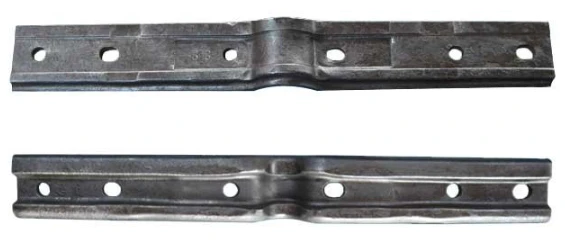
A joggled joint bar features a specialized central "joggle" or outward bulge. This offset provides clearance to safely clamp over a weld collar or cracked section without touching the weld bead, ensuring safe, temporary train operations at regulated speeds until permanent repairs can be completed.
2. Double Shoulder Tie Plates for 115RE Rails
Tie plates (or sole plates) distribute the load from the rail base to the wooden or concrete sleepers, preserving the sleepers' service life and holding the rail in correct alignment.
The 115 lbs RE and RA double shoulder tie plates are the standard choice for 115lb rail sections. Both the AREMA 115RE and the older 115RA rail sections feature a base width of 5-1/2 inches (139.7 mm). Because they share this dimension, the same double-shoulder tie plate can be used for both profiles.

- Double Shoulder Design: The plate has two raised ridges (shoulders) that flank the rail base. This design restricts lateral movement on both the gauge side and the field side, improving track gauge retention.
Punching Options: Depending on the anchoring requirement, these plates are typically punched with 4, 5, 6, or 8 square holes to accommodate dog spikes or screw spikes for secure tie anchoring.
| Model | Application | Material | Unit Weight |
| 115RE Tie plate | AREMA 115RE rail | Q235 or | 10.6kg/pc |
| QT400-15 | |||
| 132/136RE | AREMA 132RE rail | Q235 or | 11-12kg/p |
| Tie plate | AREMA 136RE rail | QT400-15 | |
| 115D Tie plate | AREMA 115D rail | Q235 or | 28.8kg/pc |
| QT400-15 | |||
| 100-8B Tie plate | AREMA 100-8B rail | Q235 or | 26kg/pc |
| QT400-15 | |||
| S49 Tie plate | S49 rail | QT450-10 | 7.57kg/pc |
| QT400-15 | |||
| Q235 |
3. Resilient Elastic Fasteners
In modern track structures, especially on concrete sleepers or ballastless tracks, resilient fastening systems replace rigid spike-and-plate assemblies. The elastic rail clip is a critical component of these systems.
GNEE RAILWAY RAILWAY provides professional-grade rail clips manufactured from high-quality spring steel. Our products are engineered for precision and can be customized to comply with varied project standards, including profile-specific fastening requirements.
| Item | Materials | Diameter | Weight | HRC | Under pressure |
| Type III | 60Si2MnA | ø18 | 0.80kg | 44-48 | ≥950kgf |
| 1809 | 60Si2MnA | ø18 | 0.63 kg | 44-48 | ≥950kgf |
| e1609 | 60Si2MnA | ø16 | 0.43 kg | 44-48 | ≥950kgf |
| e1813 | 60Si2MnA | ø18 | 0.60 kg | 44-48 | ≥950kgf |
| e2001 | 60Si2MnA | ø20 | 0.80 kg | 44-48 | ≥950kgf |
| e2007 | 60Si2MnA | ø20 | 0.80 kg | 44-48 | ≥950kgf |
| e2009 | 60Si2MnA | ø20 | 0.80 kg | 44-48 | ≥950kgf |
| e2055 | 60Si2MnA | ø20 | 0.80 kg | 44-48 | ≥950kgf |
| e2056 | 60Si2MnA | ø20 | 0.80 kg | 44-48 | ≥950kgf |
| e2063 | 60Si2MnA | ø20 | 0.80 kg | 44-48 | ≥950kgf |
| PR401 | 60Si2MnA | ø20 | 0.97 kg | 44-48 | ≥950kgf |
| PR415 | 60Si2MnA | ø20 | 0.95 kg | 44-48 | ≥950kgf |
| PR601A | 60Si2MnA | ø22 | 1.23 kg | 44-48 | ≥950kgf |
| SKL-1 | 38Si7 | ø13 | 0.53 kg | 44-48 | ≥950kgf |
| SKL-3 | 38Si7 | ø13 | 0.53 kg | 44-48 | ≥950kgf |
Frequently Asked Questions (FAQ)
Q1: Can 115RE and 115RA rails use the same double shoulder tie plates?
A: Yes. Both 115RE and 115RA rail sections have a base width of 5-1/2 inches (139.7 mm). Since the distance between the shoulders of a double-shoulder tie plate is determined by the rail base width, these plates are compatible with both profiles.
Q2: What are the benefits of toeless joint bars over traditional jointed track fishplates?
A: Toeless joint bars eliminate the bottom projecting flange (the "toe"), making them lighter and easier to install. They do not interfere with the clips or tie plates of modern resilient fastening systems and provide a cleaner geometry, facilitating maintenance in modern track configurations.
Q3: When is a TR57 joggled rail joint required?
A: A TR57 joggled joint is used as an emergency or temporary connection over a thermit weld collar or a cracked rail section. The curved middle section (the joggle) arches over the weld or crack, allowing the joint bar to clamp tightly to the rail web without causing stress concentrations on the weld itself.
Q4: What grade of bolts is recommended for 115RE joint bars?
A: High-strength track bolts, typically conforming to ASTM A449 or AREMA specifications, are recommended. A 1-inch diameter bolt is the standard size used for 115RE joints to withstand the cyclic tension and shear forces of heavy rail traffic.