


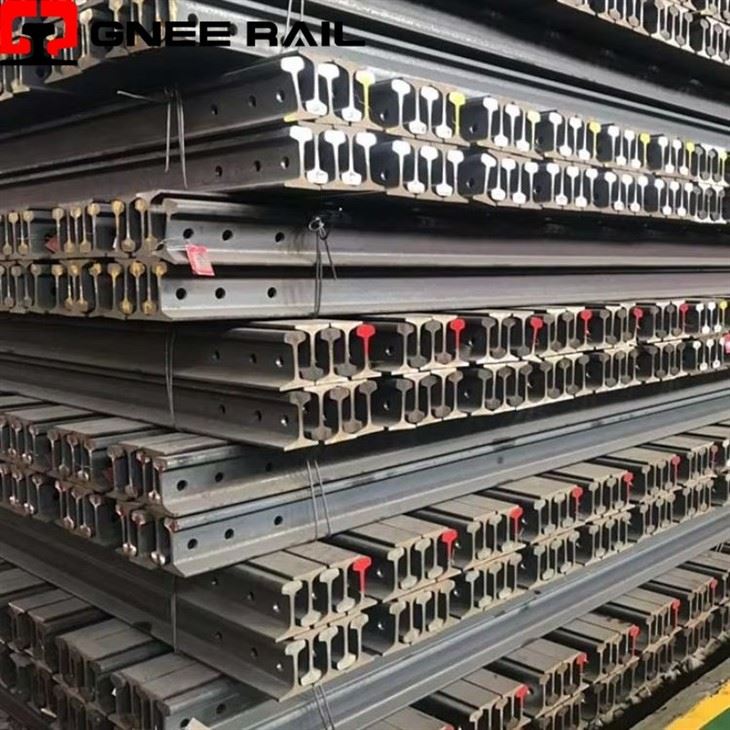


Gnee Steel (Tianjin) Co., Ltd. is one of the most reliable manufacturers and suppliers of arema 115lb rail in China, also supports customized service with low price. Please feel free to buy cheap arema 115lb rail made in China here from our factory.
AREMA 115LB Steel Rail (115RE / TR57)
The AREMA 115LB steel rail (commonly designated as the 115RE or TR57 profile) represents a cornerstone of modern railway infrastructure. Standardized by the American Railway Engineering and Maintenance-of-Way Association (AREMA) and manufactured in accordance with ASTM specifications, this heavy-duty flat-bottom rail balances structural integrity, load-bearing capacity, and cost-effectiveness. It is widely deployed across North America, South America, and global industrial corridors supporting high-traffic, heavy-haul, and mainline networks.
1. Dimensional Profile and Geometric Properties
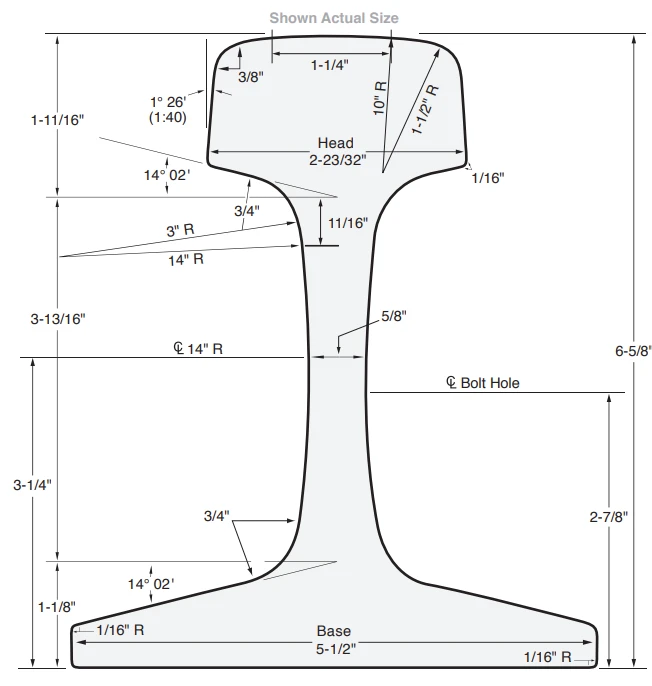
Ensuring dimensional accuracy is critical for maintaining track geometry, vehicle stability, and safety. The 115RE rail profile features specific dimensions optimized to efficiently distribute heavy axle loads to the supporting ties and ballast. The precise geometric properties in both metric and imperial systems are detailed below:
| Dimension Parameter | Metric Value (mm) | Imperial Value (inches) |
|---|---|---|
| Total Height | 168.28 mm | 6-5/8 in |
| Base (Bottom) Width | 139.70 mm | 5-1/2 in |
| Head Width | 69.06 mm | 2-23/32 in |
| Web Thickness | 15.88 mm | 5/8 in |
| Nominal Weight | 56.90 kg/m | 114.7 lbs/yd (~115 lbs/yd) |
| Cross-Sectional Area | 72.58 cm² | 11.25 in² |
2. Standard Compliance and Steel Material Grades
AREMA 115LB rails are manufactured primarily from carbon and alloy steels to withstand fatigue, wear, and environmental stress. The production processes utilize heat treatment (e.g., head hardening) to refine the microstructure. The rails comply with AREMA Chapter 4 and ASTM A1 standards, and are available in three steel grades:
- Standard Strength (SS): Tailored for general mainline tracks and low-to-medium traffic freight lines.
- Intermediate Strength (IS): Offers balanced performance for high-wear areas, sharp curves, and moderate load increases.
- High Strength / Head Hardened (HH): Featuring a fine pearlitic structure to maximize hardness and wear resistance, ideal for severe curvature, heavy haul lines, and high-abrasion mining environments.
3. Mechanical Properties and Hardness Profile
To resist plastic deformation, corrugation, and fatigue crack growth under heavy axle loads, TR57 rails must have high yield strength and surface hardness. The table below highlights the representative physical metrics for each standard grade:
| Performance Property | Standard Strength (SS) | Intermediate Strength (IH) | High Strength / Alloy (HS) |
|---|---|---|---|
| Minimum Yield Strength | ≥ 511 N/mm² (74 ksi) | ≥ 724 N/mm² (105 ksi) | ≥ 828 N/mm² (120 ksi) |
| Minimum Tensile Strength | ≥ 983 N/mm² (142.5 ksi) | ≥ 1069 N/mm² (155 ksi) | ≥ 1179 N/mm² (171 ksi) |
| Minimum Elongation (A5) | ≥ 10% | ≥ 10% | ≥ 10% |
| Surface Hardness (Brinell HBW) | ≥ 310 HBW | ≥ 350 HBW | ≥ 370 HBW |
4. Chemical Composition
The chemical composition of the rail steel dictates its performance, weldability, and resistance to wear and shell defects. The table below represents the standard metallurgical ranges specified under modern AREMA guidelines for various grades:
| Element | Standard Strength Grade (%) | Intermediate Strength Grade (%) | High Strength / Alloy Grade (%) |
|---|---|---|---|
| Carbon (C) | 0.74 – 0.86 | 0.74 – 0.86 | 0.72 – 0.82 |
| Manganese (Mn) | 0.75 – 1.25 | 0.75 – 1.25 | 0.70 – 1.25 |
| Silicon (Si) | 0.10 – 0.60 | 0.10 – 0.60 | 0.10 – 1.00 |
| Phosphorus (P) | ≤ 0.020 (Max) | ≤ 0.020 (Max) | ≤ 0.020 (Max) |
| Sulfur (S) | ≤ 0.020 (Max) | ≤ 0.020 (Max) | ≤ 0.020 (Max) |
5. TR57 Steel Rail Manufacturing Process - GNEE RAIL
The manufacturing of 115RE rails is a multi-stage process designed to produce rails that meet industry standards. By integrating metallurgical refinement, continuous casting, and controlled rolling, the process ensures dimensional accuracy and structural integrity. Final treatments and quality testing ensure that each rail meets the hardness, straightness, and surface finish requirements for safe railway operations.
| Step | Process | Description |
| 1 | Steelmaking | Melting scrap and iron in a furnace; refining to achieve exact chemical composition. |
| 2 | Continuous Casting | Pouring molten steel into casting machines to form solid steel billets. |
| 3 | Rolling | Heating and passing billets through a rolling mill to form the 115RE cross-section. |
| 4 | Cutting | Using industrial saws to trim the continuous rail into specified standard lengths. |
| 5 | Quenching & Tempering | Heat-treating to reach peak strength, followed by rapid cooling and tempering for toughness. |
| 6 | Straightening | Mechanical correction to eliminate any thermal distortion, bending, or twisting. |
| 7 | Finishing | Precision surface refinement via grinding, polishing, and shot blasting to remove defects. |
| 8 | Testing | Rigorous verification of dimensions, weight, hardness, and straightness against standards. |
GNEE RAIL employs automated inspection and testing at each production stage to control dimensional variance. As a direct manufacturer with full process control, we produce 115RE rails engineered to meet the requirements of modern heavy-haul and transit networks. Contact our engineering team today for detailed technical specifications or to discuss custom project requirements.
Frequently Asked Questions (FAQ)
Q1: What does the designation "115RE" mean in the AREMA standard?
The "115" indicates the nominal weight of the rail, which is approximately 115 pounds per yard (equivalent to 56.90 kg/m). The "RE" signifies that the rail section is designed and standardized in accordance with the American Railway Engineering (RE) recommendations.
Q2: Is the TR57 rail identical to the AREMA 115RE rail?
Yes. TR57 is a widely used international model designation representing the same exact profile as the AREMA 115RE / 115LB rail. They share identical cross-sectional geometries and physical dimensions.
Q3: Why is heat treatment critical for 115RE rails in mining and freight?
Heat treatment, particularly head hardening, optimizes the steel's pearlitic microstructure. This process substantially enhances wear resistance, mitigates rolling contact fatigue (RCF), and extends the operational lifespan of tracks subjected to severe curve abrasion and high-frequency, heavy-haul traffic.
Q4: What length options are standard for 115LB steel rails?
Standard delivery lengths typically range between 12 meters and 25 meters (or standard North American lengths of 39 feet and 80 feet). Customized lengths up to 30 meters can also be engineered and pre-drilled with fish bolt holes to match specific engineering alignments.
Q5: Which joint systems are compatible with 115RE rails?
The 115RE rails are fully compatible with standard AREMA joint bars (fishplates), featuring 4-hole (24-inch) or 6-hole (36-inch) configurations. Joint bolts are typically 1-inch in diameter to ensure structural coupling strength.
Hot Tags: arema 115lb rail, China arema 115lb rail manufacturers, suppliers, factory, QU120 For Metallurgical, Railroad Rail, Heat treated rail, Anti fracture Underground Mine, Anti fracture rail, High Strength heavy rail


