


In the rapid development of high-speed railways, there exists a group of unknown "behind-the-scenes guardians". These small yet crucial components, like exquisite "connectors", firmly anchor the rails to the sleepers and assume the key responsibility of ensuring the safe and smooth operation of high-speed trains - this is the high-speed railway rail fastener.
What are rail fasteners?
Rail fasteners are an important part of the track structure. They are used to connect rails and the supporting structure under the rails, with functions such as fixing the position of rails, providing elastic support for rails, and dispersing and transmitting vertical and lateral forces between wheels and rails. As key components ensuring the stability and smoothness of the track structure, they play a vital role in guaranteeing the safety, stability, and smoothness of train operation.

Rail fasteners, also known as rail fastener systems, are simply referred to as fasteners. With the development of railways, rail fasteners have been constantly evolving. In the early days of railway development, rails were fixed by spikes driven into sleepers. Later, with the popularization and application of concrete sleepers, ballasted track rail fasteners that use anchoring connections to fix rails came into being. Nowadays, the development of ballastless tracks has further led to the emergence of matching ballastless track rail fasteners.
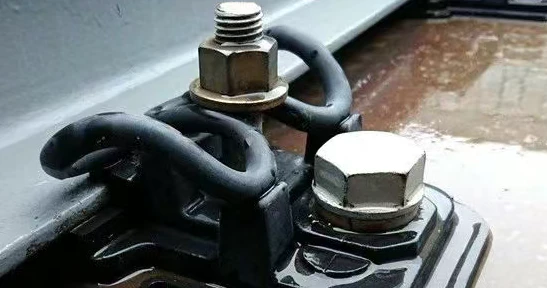
The basic function of rail fasteners is to achieve a reliable connection between the rail and the under-rail supporting structure, and to ensure that the rail is in the correct geometric position. In addition, rail fasteners also have the following functions: providing elastic support for the rail to reduce the stiffness of the track structure, mitigating wheel-rail impact, improving the stress state of the under-rail supporting structure, and reducing structural vibration and noise; providing sufficient clamping force and longitudinal resistance for the rail to ensure that the track frame has sufficient lateral stiffness, preventing the rail from lateral instability and longitudinal creep; providing a certain adjustment margin for rail height and gauge to meet the needs of maintaining rail surface smoothness; providing electrical insulation for the track circuit to ensure the normal operation of the track circuit.
Components of Rail Fasteners
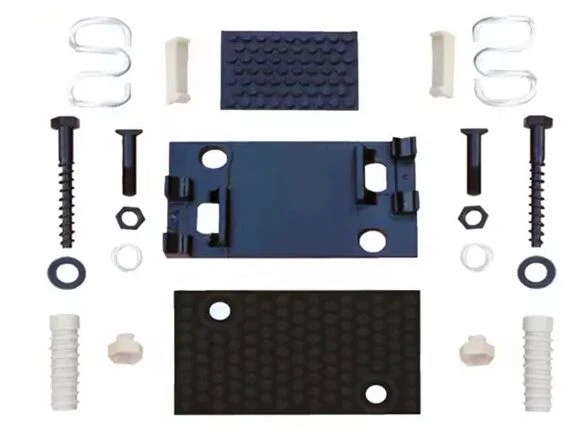
Clamping components
Clamping components are parts used to clamp rails in rail fastener systems and are essential key components in any type of rail fastener. Each set of rail fasteners includes two clamping components, which clamp the bottom of both sides of the rail respectively. They fix the rail on the under-rail supporting structure by applying clamping force to the rail, preventing the rail from tipping over under the action of wheel-rail forces, while ensuring that the rail bottom has sufficient longitudinal frictional resistance.
According to whether the clamping components have elasticity, they can be divided into two categories: rigid clamping components and elastic clamping components. Rigid clamping components lack elasticity and are more prone to loosening under the long-term effect of rail vibration, so they are rarely used on main-line railways at present. Elastic clamping components, on the other hand, can not only follow the rail movement well, providing more stable clamping effect on the rail, but also absorb impact energy from the rail through their elastic deformation and buffer vibrations, thus being widely applied.

Elastic clamping components mainly include two types: spring plates and elastic clip. They are made of spring steel plates and spring steel bars respectively. Since spring plates can only utilize the bending deformation of the material, while elastic bars can utilize both the bending and torsional deformation of the material, the elasticity of elastic bars is generally better than that of spring plates. There are various structural types of elastic bars, among which the ω-shaped and e-shaped elastic bars are the most representative and widely used.
The elastic pad is a component in the rail fastener that provides elastic support for the rail and evenly transmits the vertical and lateral loads from the rail to the under-rail supporting structure, and is usually habitually called the under-rail rubber pad. By installing an elastic pad under the rail, the elasticity of the track structure can be effectively improved, which helps to mitigate the dynamic interaction between the wheel and rail, suppress the vibration and noise of the track structure, improve the stress state of the under-rail structure, and slow down or avoid the occurrence of damage and diseases in the track structure.

According to the different installation positions of elastic pads, they can be divided into two categories: under-rail pads and under-iron tie plate pads. The iron tie plate is a metal component that some rail fasteners are arranged between the rail base and the under-rail supporting structure, which functions to disperse wheel-rail loads, protect elastic pads and reduce rail tipping. Elastic pads are usually made of polymer materials, such as natural rubber (NR), styrene-butadiene rubber (SBR), chloroprene rubber (CR), high-density polyethylene (HDPE), ethylene-vinyl acetate copolymer (EVA), thermoplastic elastomer (TPE), thermoplastic polyester elastomer (TPEE), etc.
To increase the deformation of the elastic pad under external loads and thereby further reduce its stiffness, grooves are usually made on the surface of the elastic pad or its surface is designed into a specific shape. In addition, for sections such as bridges where it is necessary to reduce the longitudinal resistance of the rail, rail fasteners typically adopt composite pads. Composite pads are formed by vulcanizing stainless steel plates and rubber, which can reduce the friction coefficient between the rail base and the pad, thereby reducing the longitudinal resistance of the rail.
Fasteners are components in rail fasteners used to secure clamping components or iron tie plates. For concrete sleeper fasteners and ballastless track fasteners, fasteners are usually threaded components, including different types such as anchor bolts, T-bolts, and screw spikes. Among them, anchor bolts and screw spikes are used in conjunction with pre-embedded sleeves that are pre-inserted into concrete sleepers or track slabs, and T-bolts are used in conjunction with iron tie plates.

When installing fasteners, a certain torque is applied to the fasteners to generate a pre-tightening force acting on the clamping components or iron tie plates, thereby fixing the clamping components and iron tie plates. Fasteners that use the same set of fasteners to fasten both the clamping components and the iron tie plates are called non-separated fasteners, while those that use two separate sets of fasteners to fasten the clamping components and the iron tie plates respectively are called separated fasteners.
Some fasteners can achieve the fastening of clamping components and iron tie plates without the need for fasteners. Therefore, fasteners can be divided into bolted fasteners and boltless fasteners according to the fastening method. Bolted fasteners have more components, which facilitates the adjustment of the rail height. However, since bolted connections are prone to loosening under long-term vibration, regular re-tightening is required. In addition, the threaded parts of the fasteners need to be oiled for rust prevention, resulting in a relatively large amount of maintenance work. Boltless fasteners have fewer components, eliminating the need for re-tightening bolts and oiling, which can significantly reduce maintenance workload. However, they have the disadvantage of being inconvenient to adjust the rail height and clamping force.
Other components
In rail fasteners, components that maintain or adjust the gauge include insulated gauge blocks, pre-embedded iron seats, gauge baffles, and gauge baffle seats, etc. Components that adjust the rail height include under-rail height-adjusting pads, under-iron tie plate height-adjusting pads, and filling pads, etc. As for components providing electrical insulation, since parts such as elastic pads, insulated gauge blocks, baffle seats, and pre-embedded sleeves all have good insulation performance, the insulation performance of rail fasteners is ensured by these components.

In addition, some fastener components also play a role in transmitting the lateral force of the fastener. Rail fasteners can be divided into shoulder-type fasteners and shoulderless fasteners according to whether the under-rail supporting structure is equipped with shoulders. For shoulder-type fasteners, the lateral force of the fastener is transmitted to the under-rail supporting structure through the shoulder via components such as gauge baffles and gauge baffle seats. For shoulderless fasteners, the lateral force is balanced by the lateral reaction force of components such as fasteners and pre-embedded iron seats, or the frictional resistance on the surface of the iron tie plate.
Four common types of fasteners for high-speed railways
Type WJ-7 is a separated shoulderless fastener, which is suitable for CRTSⅠslab-type or CRTS double-block SK-1 type sleepers in ballastless tracks.

The WJ-7 type fastener consists of T-bolts, nuts, flat washers, elastic bars, insulation blocks, iron tie plates, under-rail pads (rubber pads or composite pads), insulation buffer pads, heavy-duty spring washers, flat cushion blocks, anchor bolts and pre-embedded sleeves. It may also include under-rail height-adjusting pads (or filling pads) and under-iron tie plate height-adjusting pads.
Type WJ-8 is a non-separated shoulder-type fastener, which is suitable for CRTSⅡ slab-type, CRTSⅢ slab-type or CRTS double-block SK-2 type sleepers in ballastless tracks.

The WJ-8 type fastener consists of screw spikes, flat washers, elastic bars, insulated gauge blocks, gauge baffles, under-rail pads, iron tie plates, elastic pads under iron tie plates and pre-embedded sleeves. In addition, for the need of adjusting the vertical position of the rail, it also includes under-rail fine adjustment pads and height-adjusting pads under iron tie plates.
Type IV elastic clip fastener is a boltless fastener, which is suitable for type Ⅲb shoulderless concrete sleepers in ballasted tracks.

Type IV elastic clip fastener consists of elastic clips, insulated gauge blocks, rubber pads and pre-embedded iron seats.

Type V elastic clip fastener is a bolted fastener, which is suitable for type Ⅲc shouldered concrete sleepers in ballasted tracks.

The Type V elastic clip fastener consists of screw spikes, flat washers, elastic clips, gauge baffles, under-rail pads and pre-embedded sleeves. In addition, for the need of adjusting the rail height, it also includes height-adjusting pads.

As a professional supplier of railway fasteners, GNEE RAILWAY RAILWAY is committed to providing cost-effective rail connection solutions to customers around the world. Our main products include various types of spring clips, sleeper bolts, insulating washers and other railway-specific fasteners, which are suitable for traditional railways, high-speed railways and urban rail transit projects. We strictly control every link from raw material procurement to finished product delivery to ensure that our products meet international railway industry standards.