


Information Required Before Calculating Crane Rail Quantities
Before calculating the number of crane rails required, buyers should confirm several basic project details. Incorrect information at this stage can result in insufficient material, unnecessary surplus or inaccurate freight estimates.
Confirm the Crane Rail Profile
The first step is to identify the required crane rail profile.
Common DIN 536-1 crane rail profiles include:
A45
A55
A65
A75
A100
A120
Each profile has different cross-sectional dimensions and theoretical weight per metre.
For example:
| Crane Rail Profile | Commonly Referenced Theoretical Weight |
|---|---|
| A65 | 43.10 kg/m |
| A75 | 56.20 kg/m |
These values are useful for preliminary weight calculations. The final values should be confirmed against the applicable standard edition and the manufacturer's approved technical datasheet.
Do not calculate the total order weight using the wrong rail profile. Even when two projects require the same total length, their order weights can differ significantly if the rail profiles are different.
Confirm Whether 1,000 Metres Means Track Length or Total Rail Length
This is an important point that buyers should clarify before calculating quantities.
There is a difference between:
Track route length: The length of the crane runway or track layout.
Total rail length: The combined length of all individual rails required for the installation.
For example, if a crane runway has two parallel rails and each rail line is 1,000 metres long, the total rail requirement is:
1,000 m × 2 = 2,000 m
If the buyer requires 1,000 metres of total rail material, the calculation is different.
This article uses 1,000 metres as the total required length of individual crane rail, not the route length of a two-rail runway.
Before requesting quotations, confirm whether the project quantity refers to one rail line, both parallel rail lines or the combined material length.
Confirm Available Crane Rail Lengths
Crane rails can be requested in different lengths according to manufacturing capability and project requirements.
Common inquiry options include:
6 m
9 m
12 m
Other specified lengths
The selected length affects the number of pieces, total supplied length, number of joints and handling arrangements.
Buyers should confirm the available production lengths with the supplier before finalizing the purchase quantity.
Check Rail Joint and Installation Requirements
The theoretical quantity calculation does not automatically account for the actual track layout.
Before placing an order, check:
The number and location of rail joints.
The required connection method, such as fishplates or another specified joint arrangement.
Whether rails need to be cut to specific lengths.
Whether the project includes curves, transitions or special sections.
Whether spare rails are required for installation or future maintenance.
These details may affect the final order quantity and should be reviewed against the project drawings and bill of quantities (BOQ).
How to Calculate the Number of Crane Rail Pieces
The basic calculation is straightforward: divide the required total rail length by the length of one individual rail.
However, because crane rails are generally purchased in complete pieces, the result must be rounded up to the next whole number.
Basic Calculation Formula
The formula is:
Number of Rails = Required Total Rail Length ÷ Individual Rail Length
If the result is not a whole number, round it up.
The actual supplied length is then calculated as:
Actual Supply Length = Number of Rails × Individual Rail Length
The additional length is:
Extra Length = Actual Supply Length − Required Total Rail Length
Example: 1,000 Metres with 6 m Crane Rails
Suppose a buyer requires 1,000 metres of crane rails and the supplier can provide 6 m individual rails.
The calculation is:
1,000 ÷ 6 = 166.67
Since the buyer cannot purchase 166.67 complete rail pieces, the quantity must be rounded up.
Required quantity:
167 pieces
Actual supply length:
167 × 6 = 1,002 m
Extra length:
1,002 − 1,000 = 2 m
Therefore, the buyer needs 167 pieces of 6 m crane rail, providing a total supply length of 1,002 metres.
Example: 1,000 Metres with 9 m Crane Rails
If the buyer selects 9 m crane rails:
1,000 ÷ 9 = 111.11
Rounded up:
112 pieces
Actual supply length:
112 × 9 = 1,008 m
Extra length:
1,008 − 1,000 = 8 m
The order would therefore require 112 pieces of 9 m crane rail, providing 1,008 metres in total.
Example: 1,000 Metres with 12 m Crane Rails
If the buyer selects 12 m crane rails:
1,000 ÷ 12 = 83.33
Rounded up:
84 pieces
Actual supply length:
84 × 12 = 1,008 m
Extra length:
1,008 − 1,000 = 8 m
The order would therefore require 84 pieces of 12 m crane rail, providing 1,008 metres in total.
Comparison of Different Rail Length Options
The following table compares the purchasing quantities for a project requiring at least 1,000 metres of total rail material.
| Individual Rail Length | Calculation | Required Quantity | Actual Supply Length | Extra Length |
|---|---|---|---|---|
| 6 m | 1,000 ÷ 6 | 167 pcs | 1,002 m | 2 m |
| 9 m | 1,000 ÷ 9 | 112 pcs | 1,008 m | 8 m |
| 12 m | 1,000 ÷ 12 | 84 pcs | 1,008 m | 8 m |
The 6 m option provides the smallest additional length in this example. However, this does not automatically mean it is the most economical option.
The number of joints, installation conditions, cutting requirements, transportation and handling costs should also be considered.
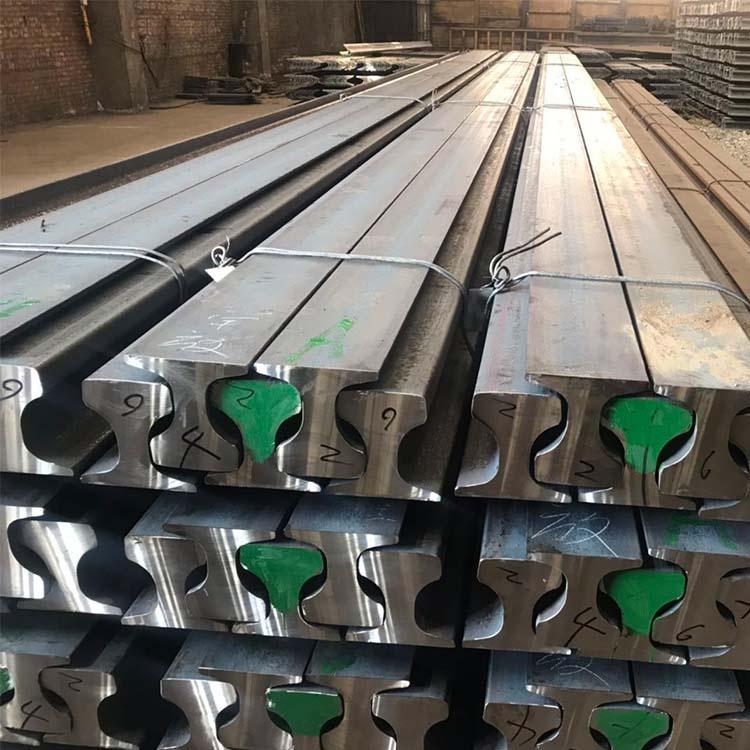
Crane Rail for Industrial Projects
How to Calculate the Total Weight of Crane Rails
This figure is useful for:
Comparing supplier quotations.
Estimating material costs.
Planning truck or container loading.
Calculating transportation requirements.
Estimating unloading and handling requirements.
Crane Rail Weight Calculation Formula
The basic formula is:
Total Theoretical Weight = Theoretical Weight per Metre × Actual Supply Length
For example, if a crane rail has a theoretical weight of 43.10 kg/m and the actual supply length is 1,002 metres:
43.10 × 1,002 = 43,186.20 kg
The estimated theoretical order weight is 43,186.20 kg.
Example: A65 Crane Rail for a 1,000 Metre Project
Assume the project requires:
Rail profile: A65
Theoretical weight: 43.10 kg/m
Required total length: 1,000 m
Available rail lengths: 6 m, 9 m and 12 m
The calculated quantities are:
| Rail Length | Quantity | Actual Supply Length |
|---|---|---|
| 6 m | 167 pcs | 1,002 m |
| 9 m | 112 pcs | 1,008 m |
| 12 m | 84 pcs | 1,008 m |
The estimated theoretical weight for each option is:
6 m option:
1,002 × 43.10 = 43,186.20 kg
9 m option:
1,008 × 43.10 = 43,444.80 kg
12 m option:
1,008 × 43.10 = 43,444.80 kg
The results show that the 6 m option has a lower theoretical order weight because its rounded-up supply length is shorter.
Example: A75 Crane Rail for a 1,000 Metre Project
Now consider the same project using A75 crane rails.
Assumed specifications:
Rail profile: A75
Theoretical weight: 56.20 kg/m
Required total length: 1,000 m
Available rail lengths: 6 m, 9 m and 12 m
The estimated theoretical weights are:
6 m option:
1,002 × 56.20 = 56,312.40 kg
9 m option:
1,008 × 56.20 = 56,649.60 kg
12 m option:
1,008 × 56.20 = 56,649.60 kg
A65 and A75 Total Weight Comparison
The following table summarizes the estimated theoretical weights for the two profiles.
| Rail Profile | Theoretical Weight | 6 m Option: 1,002 m | 9 m Option: 1,008 m | 12 m Option: 1,008 m |
|---|---|---|---|---|
| A65 | 43.10 kg/m | 43,186.20 kg | 43,444.80 kg | 43,444.80 kg |
| A75 | 56.20 kg/m | 56,312.40 kg | 56,649.60 kg | 56,649.60 kg |
These calculations use the commonly referenced theoretical weights stated above. Actual product weight and shipment weight should be confirmed using the approved product specifications and manufacturer's production or weighing records.
Buyers should also distinguish between theoretical rail weight and gross shipment weight. Packaging materials, steel straps, wooden supports and other packing materials may increase the final shipping weight.
Request a Crane Rail Weight Calculation
How to Choose Between 6 m, 9 m and 12 m Crane Rails
Material Quantity and Cutting Loss
Different rail lengths can produce different amounts of additional material after the quantity is rounded up.
For the 1,000 metre example:
6 m rails provide 1,002 m, with 2 m extra.
9 m rails provide 1,008 m, with 8 m extra.
12 m rails provide 1,008 m, with 8 m extra.
However, the extra length is not necessarily usable as installation material. Its usability depends on the track layout, cutting plan and joint arrangement.
If the project requires specific individual rail lengths, buyers should calculate the cutting plan rather than relying only on the total length calculation.
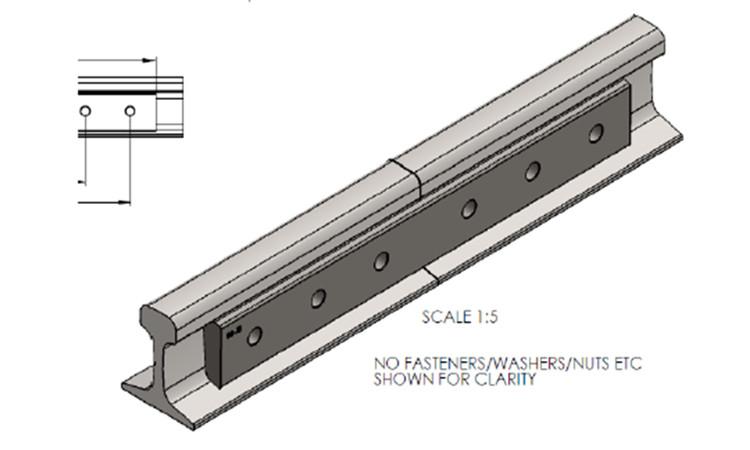
Rail Joint Arrangement
The selected rail length affects the number of rail pieces and potential joint locations.
For example, a 1,000 metre material requirement using 6 m rails needs more individual pieces than a 12 m rail option.
This may affect:
The number of rail joints.
The quantity of fishplates or other specified joint components.
Installation labor.
Joint positioning and alignment work.
The actual joint arrangement must follow the project drawings and installation requirements.
Crane Rail Joint Arrangement with Fishplates
Transportation and Unloading
Longer crane rails may require additional attention during transportation and handling.
Buyers should confirm:
Whether the selected rail length fits the planned transport arrangement.
Whether the loading and unloading equipment can handle the individual rail length and weight.
Whether the destination site has sufficient space for unloading and storage.
Whether the shipment requires special arrangements for long cargo.
The supplier should confirm the actual bundle dimensions and weights before shipment planning.
Installation Conditions
The site layout may influence the most suitable rail length.
For example, a project with limited installation space or specific cutting requirements may need a different length arrangement from a project with a straightforward, long runway.
Buyers should consider:
Available installation space.
Crane runway layout.
Rail support and fastening arrangement.
Required joint positions.
Site cutting and welding restrictions, if any.
Any cutting, drilling or other rail processing should follow the approved project drawings and technical requirements.
Compare the Total Project Cost
The lowest material weight or smallest number of rail pieces does not necessarily result in the lowest total project cost.
A useful comparison should include:
| Cost Factor | What Buyers Should Compare |
|---|---|
| Rail material cost | Price per metre or per tonne |
| Actual supply quantity | Total length after rounding |
| Joint components | Fishplates, bolts or other specified accessories |
| Installation cost | Labor and installation time |
| Cutting cost | Site cutting and processing requirements |
| Transportation | Freight, loading and unloading costs |
| Handling | Equipment and storage requirements |
The best rail length is the one that matches the project layout and provides a practical balance between material usage, installation and logistics costs.
Should You Add Extra Crane Rails to the Order?
A project may require additional crane rail material beyond the basic calculated quantity. However, buyers should not automatically apply the same additional percentage to every project.
The required allowance depends on the actual installation and purchasing requirements.
Cutting and Processing Allowance
If rails need to be cut into specific lengths, the purchasing quantity should be checked against the cutting plan.
For example, a project may require several different individual rail lengths rather than a continuous sequence of standard-length pieces.
In this situation, buyers should calculate how many standard rails are needed to produce the required sections and identify the remaining usable material.
A cutting plan can help reduce unnecessary material waste.
Installation and Replacement Allowance
Some projects require spare rails for installation adjustments, future maintenance or replacement.
The spare quantity should be confirmed by the project owner, engineering team or purchasing specification.
It should not be assumed that every 1,000 metre project needs the same number of additional rails.
Why Buyers Should Not Apply a Fixed Waste Percentage
Adding a fixed percentage, such as 3% or 5%, without reviewing the project layout can result in unnecessary purchasing costs.
The additional quantity should be based on:
Actual track layout.
Required individual rail lengths.
Cutting and processing arrangements.
Joint positions.
Project spare-material requirements.
For export orders, buyers should also distinguish between extra rail length caused by whole-piece rounding and additional material deliberately purchased as spare stock.
Crane Rail Quantity Calculation Example: From Project Length to Purchase Order
The following example combines the main calculations into a practical purchasing scenario.
Assume a buyer is preparing an inquiry for a crane rail project with these requirements:
| Project Information | Requirement |
|---|---|
| Rail Profile | A65 |
| Applicable Standard | DIN 536-1 |
| Required Total Rail Length | 1,000 m |
| Available Rail Lengths | 6 m and 12 m |
| Theoretical Weight | 43.10 kg/m |
| Material Certificate | EN 10204 3.1, if required by the project |
| Delivery Destination | To be confirmed |
The buyer wants to compare 6 m and 12 m rail options.
Purchase Quantity Comparison
| Item | 6 m Option | 12 m Option |
|---|---|---|
| Individual Rail Length | 6 m | 12 m |
| Required Quantity | 167 pcs | 84 pcs |
| Actual Supply Length | 1,002 m | 1,008 m |
| Extra Length | 2 m | 8 m |
| Theoretical Weight | 43.10 kg/m | 43.10 kg/m |
| Estimated Total Weight | 43,186.20 kg | 43,444.80 kg |
What Should Be Confirmed Before Ordering?
After completing the basic calculation, the buyer should confirm the following:
Whether 1,000 m represents the total material length or the route length of a two-rail runway.
Whether the selected rail length is suitable for the installation layout.
Whether the extra length can be used in the actual cutting and installation plan.
Whether the required rail joints and fishplates are included in the purchasing scope.
Whether additional spare rails are required.
Whether the supplier can provide the specified steel grade and inspection documentation.
Whether the estimated total weight is suitable for the planned shipping arrangement.
The final purchase order should state the agreed rail profile, length, quantity, material requirements and delivery conditions.
Ask Us to Check Your Crane Rail BOQ
Common Mistakes When Calculating Crane Rail Quantities
Even a straightforward 1,000 metre calculation can result in purchasing errors if important details are overlooked.
Rounding Down the Required Quantity
One common mistake is rounding down the result instead of rounding up.
For example:
1,000 ÷ 6 = 166.67
Purchasing 166 pieces would provide:
166 × 6 = 996 m
This is 4 metres short of the required 1,000 metres.
The correct quantity is 167 pieces, providing 1,002 metres.
Calculating Weight Based on 1,000 m Instead of Actual Supply Length
Another mistake is calculating the total weight using exactly 1,000 metres after the purchasing quantity has already been rounded up.
For example, the 6 m A65 option requires 167 pieces, giving 1,002 metres.
The correct theoretical weight calculation is:
1,002 × 43.10 = 43,186.20 kg
Using only 1,000 metres would give 43,100 kg, which does not represent the full calculated supply quantity.
Confusing Different Crane Rail Profiles
A65, A75 and A100 have different cross-sectional dimensions and theoretical weights.
Buyers should use the correct theoretical weight for the specified profile. Using the A65 weight to calculate an A75 order will produce an incorrect total weight.
Ignoring Rail Joint and Cutting Requirements
A simple length calculation does not determine the final installation arrangement.
If the project requires specific joint locations, cut lengths or special rail sections, the buyer should provide the track layout and cutting requirements before confirming the order quantity.
Ignoring Spare Material Requirements
Some projects require spare rails, but the quantity should be confirmed by the project specification or maintenance plan.
Do not assume that the whole-piece rounding surplus automatically provides enough spare material for the project.
Confusing Track Length with Total Rail Length
For a runway with two parallel rails, a 1,000 metre route may require approximately 2,000 metres of rail material before additional allowances.
This is one of the most important details to confirm when preparing a crane rail inquiry.
Information to Include in a Crane Rail RFQ
When requesting a quotation for a 1,000 metre crane rail project, buyers should provide enough information for the supplier to check the required profile, quantity and delivery arrangement.
| RFQ Information | Details to Provide |
|---|---|
| Rail Profile | A65, A75, A100 or another specified profile |
| Applicable Standard | DIN 536-1 or project-specific standard |
| Steel Grade | As required by the project specification |
| Total Required Length | e.g. 1,000 m |
| Track Configuration | Single rail line, two parallel rails or total material length |
| Individual Rail Length | 6 m, 9 m, 12 m or custom length |
| Required Quantity | Pieces or total metres |
| Inspection Certificate | EN 10204 3.1, if required |
| Fastening Components | Clips, clamps, bolts, fishplates or other accessories |
| Delivery Destination | Destination port or project location |
| Trade Terms | FOB, CFR, CIF or another agreed Incoterm |
Providing the BOQ and engineering drawings is particularly helpful when the project includes multiple rail lengths, special cutting requirements or specific joint arrangements.
Send Your Drawings and BOQ for a Crane Rail Quotation
FAQ
Q: How many 6 m crane rails are needed for a 1,000 metre project?
A: A total of 167 pieces of 6 m crane rail are required to provide at least 1,000 metres. The actual supply length is 1,002 metres.
Q: How many 9 m crane rails are needed for a 1,000 metre project?
A: A total of 112 pieces of 9 m crane rail are required. The actual supply length is 1,008 metres.
Q: How many 12 m crane rails are needed for a 1,000 metre project?
A: A total of 84 pieces of 12 m crane rail are required. The actual supply length is 1,008 metres.
Q: Is 1,000 metres the same as the purchasing quantity?
A: Not necessarily. The actual purchasing quantity depends on the selected rail length, whole-piece rounding, cutting requirements, track configuration and project spare-material requirements.
Q: How do you calculate the total weight of crane rails?
A: Multiply the theoretical weight per metre by the actual total supply length.
For example, if A65 crane rail has a theoretical weight of 43.10 kg/m and the actual supply length is 1,002 m:
43.10 × 1,002 = 43,186.20 kg
Q: Are 6 m or 12 m crane rails more economical?
A: There is no universal answer. Buyers should compare the actual material quantity, joint arrangement, cutting requirements, installation cost, transportation and handling costs.
Q: Should extra crane rails be included in the order?
A: Extra rails should be included when required by the project design, cutting plan, maintenance policy or purchasing specification. A fixed additional percentage should not be assumed for every project.
Q: Does a 1,000 metre crane runway require 1,000 metres of crane rails?
A: Not necessarily. If the runway has two parallel rail lines, each 1,000 metres long, the combined rail material requirement is approximately 2,000 metres before additional allowances. Buyers should confirm the track configuration before calculating the order quantity.