


What Are the Different Types of Rail Pads?
Rail pads can prevent rail sleeper abrasion and the crushing of the sleeper under the rail foot. Rubber rail pads are normally designed to a specified load-deflection characteristic. The initial stiffness of the rail pad is designed to be low so that that their deformations under the springs toe loads is quite substantial. This ensures that the rail pad remains in intimate contact with the rail despite any vertical movements of the latter. When the wheel is over the pad, the rail pad stiffness must be high to prevent large movements which can result in the metal spring becoming loose. Such a load-deflection characteristic can be obtained by introducing grooves in the rubber rail pads. Rubber pad or grooved rubber rail pad are made up of rubber or plastic to dampen the shocks of vibrations of a passing train.
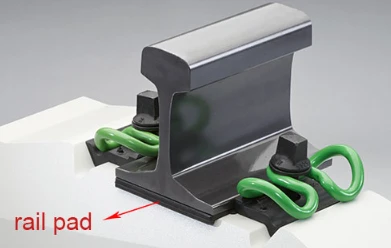
Classification by Material: Thermoplastics vs. Elastomers
The most fundamental distinction lies in the material composition, which dictates the pad's performance.
- The first major category includes Thermoplastic Pads, predominantly made from HDPE (High-Density Polyethylene) or EVA. These types of Railroad Pads are characterized by their high stiffness and durability. They function primarily as a rigid, wear-resistant interface to protect the sleeper from abrasion, making them ideal for heavy freight lines where gauge retention is priority over vibration damping.

| HDPE Rail Pad | |||
| Technical Parameter | Unit | Technical Requirement | Value |
| Density | g/cm3 | 0.95-0.98 | 0.95 |
| Tensile Strength | Mpa | ≥19 | 19 |
| Elongation | % | >80 | 150 |
| Melting Point | ℃ | 170-190 | 190 |
| Insulation Resistance | Ω | ≥1×10¹⁰ | 3.5 ×10¹⁰ |
| Hardness | A | ≥98 | 98(A) |
| EVA: Polyethylene 80%, Vinyl Acetate 20%. | |||
| Technical Parameter | Unit | Technical Requirement | Value |
| Density | g/cm3 | 0.95-0.98 | 0.95 |
| Tensile Strength | Mpa | ≥15 | 16 |
| Elongation | % | >500 | 550 |
| Melting Point | ℃ | 170-190 | 170 |
| Insulation Resistance | Ω | ≥1×10¹⁰ | 5.0 ×10¹⁰ |
| Hardness | A | ≥90 | 92(A) |
- The second category consists of Elastomers, or Rail Rubber Pads. Manufactured from natural or synthetic rubber, these Rail Elastic Pads often feature grooved or studded surfaces. Their primary role is to provide significant vertical deflection, absorbing high-frequency vibrations essential for passenger comfort on High-Speed Rail networks.

| Rubber Rail Pad | ||
| Technical Parameter | Unit | Value |
| Stiffness | KN | 90-130 |
| Hardness Shore A | ℃ | 72-80 degree |
| Electronic Resistance | Ω | ≥ 106 |
| Tensile Strength before Aging | Mpa | ≥12.5 |
| Elongation before Aging | % | ≥250 |
Classification by Placement: Under Rail vs. Under Sleeper
Traditionally, the term "rail pad" referred exclusively to the component sandwiched between the steel rail and the sleeper. However, modern engineering has introduced a game-changing variant known as the Under Sleeper Pad (USP). Unlike the standard Track Pad, the USP is attached to the bottom surface of the concrete sleeper, resting directly on the ballast. This innovative type increases the contact area with the ballast stones and provides a secondary layer of vibration attenuation. Advanced railway projects now frequently specify both high-quality rail pads and USPs to create a dual-elasticity system for maximum noise reduction and track stability.

GNEE RAILWAY RAILWAY: Your Source for Every Type
Navigating the various types of pads and their specific standards can be complex. GNEE RAILWAY RAILWAY simplifies this by offering a comprehensive manufacturing portfolio. We produce everything from cost-effective HDPE pads for industrial sidings to high-performance, high-damping Rubber Track Pads for urban transit systems, complying with international standards like UIC and AREMA.

Whether your specification calls for a rigid pad to handle heavy axle loads or a soft, resilient pad for a noise-sensitive bridge section, GNEE RAILWAY RAILWAY has the capability to customize the solution. Contact our team today to explore our full range of rail pad types and find the perfect match for your infrastructure.