


Differences between EVA rail pads and HDPE rail pads
In the specification of railway fastening systems, apart from standard rubber, thermoplastic materials like HDPE (High-Density Polyethylene) and EVA (Ethylene Vinyl Acetate) dominate the market. For procurement managers, these two types of Rail Pads may look remarkably similar on a technical drawing, yet they exhibit distinct physical properties and cost structures. Understanding the nuances between them is essential for optimizing both track performance and project budget.
Rail pad functions
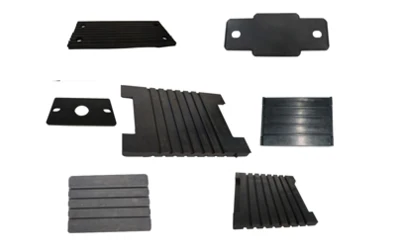
A rail rubber pad is essential in reducing shock and vibration in a rail system. The pad laid under the rail to ensure:
Load distribution over a larger surface
Elimination of load concentration and the resultant fatigue stresses
Centering of loads on the supporting element
Absorption of uneven contact surfaces between rail and support
Reduction of noise and vibration
Sealing between the bottom of the rail and the top of the support
Reduction of wear of the rail and its support
HDPE Railway Pads
The HDPE Pad is renowned for its high stiffness and structural integrity. Characterized by a dense molecular structure, it acts less like a cushion and more like a durable shield. Its primary function is to provide a rigid separation layer that prevents the steel rail from abrading the concrete sleeper, rather than absorbing vibration. This makes the Railroad Pad made from HDPE the preferred choice for heavy-haul freight lines where maintaining precise track gauge is critical. Under immense axle loads, a softer pad might compress too much, risking rail rollover, whereas HDPE remains stable. Economically, it is often the most cost-effective option among various Track Pad materials.

| HDPE Rail Pad | |||
| Technical Parameter | Unit | Technical Requirement | Value |
| Density | g/cm3 | 0.95-0.98 | 0.95 |
| Tensile Strength | Mpa | ≥19 | 19 |
| Elongation | % | >80 | 150 |
| Melting Point | ℃ | 170-190 | 190 |
| Insulation Resistance | Ω | ≥1×10¹⁰ | 3.5 ×10¹⁰ |
| Hardness | A | ≥98 | 98(A) |
EVA Railroad Pads
On the other hand, the EVA Railway Pad serves as a sophisticated middle ground between rigid plastic and elastic rubber. As a copolymer, EVA integrates the toughness of polyethylene with the flexibility of vinyl acetate. The defining difference lies in its elasticity; EVA is significantly softer than HDPE, allowing it to function effectively as a Rail Elastic Pad. It offers moderate vibration damping properties, making it suitable for mixed-traffic lines or urban transit systems where noise reduction is a factor. While slightly more expensive than HDPE, EVA excels in fatigue resistance and performs exceptionally well in cold climates without becoming brittle.

| EVA: Polyethylene 80%, Vinyl Acetate 20%. | |||
| Technical Parameter | Unit | Technical Requirement | Value |
| Density | g/cm3 | 0.95-0.98 | 0.95 |
| Tensile Strength | Mpa | ≥15 | 16 |
| Elongation | % | >500 | 550 |
| Melting Point | ℃ | 170-190 | 170 |
| Insulation Resistance | Ω | ≥1×10¹⁰ | 5.0 ×10¹⁰ |
| Hardness | A | ≥90 | 92(A) |
Customized Material Solutions at GNEE RAILWAY RAILWAY
Ultimately, the choice between HDPE and EVA depends on the required "system stiffness" of your track design. At GNEE RAILWAY RAILWAY, we go beyond off-the-shelf products. We understand that slight adjustments in chemical formulation can drastically alter performance. Our manufacturing capabilities allow us to fine-tune the vinyl acetate content in our EVA pads to achieve the exact flexibility your engineers require. Whether you need the unyielding strength of an HDPE pad for an industrial line or the resilient durability of an EVA pad for a commuter network, GNEE RAILWAY RAILWAY delivers products certified to AREMA, UIC, and DIN standards.