


Railway fasteners are a collection of key components used to connect rails and sleepers (or track plates) in the railway track system. Their performance is directly related to the safety, stability and comfort of train operation.
Core functions and working principles
The core task of railway fasteners is to firmly fix the rails on the sleepers to ensure the stability of the rail position when the train is running. During the operation of the train, the wheels exert huge vertical pressure, lateral thrust and vibration impact on the rails, and these forces will be quickly transmitted to the fastener system. At this time, the fasteners rely on their own structural design and material properties, through the elastic deformation of the spring bar and the buffering effect of the pad, etc., to effectively absorb and disperse the load, prevent the rails from lateral displacement, flipping or longitudinal creeping, and reduce fatigue damage to track components, thereby extending the service life of the track.
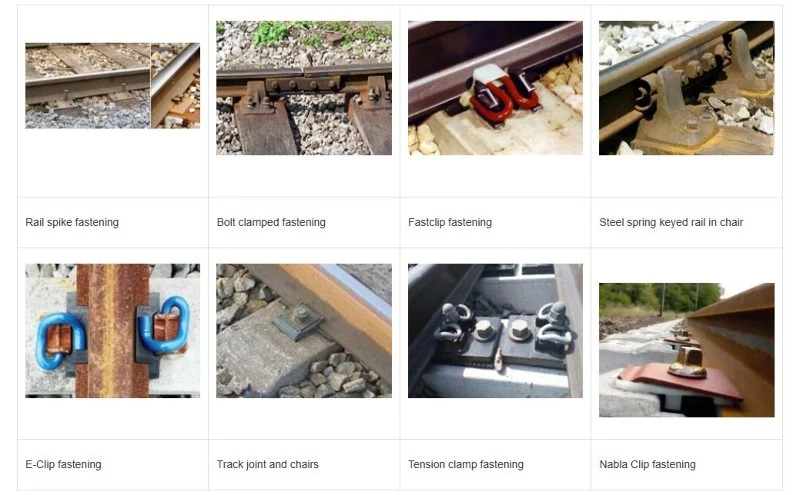
Main types and features
Classification by connection method
Non-separate fasteners: directly fix the rails on the sleepers. If pads are provided, the rails and pads are also fixed by the same set of fasteners, such as spring bar type IV fasteners. It has a compact structure, strong integrity, and stable buckling pressure. It is suitable for high-speed railways and heavy-duty railways with high requirements for track stability.
Separate fasteners: adopt step-by-step fixing. First, use fasteners to fix the rails to intermediate components such as iron pads, and then fix the intermediate components to the sleepers, such as WJ-7 fasteners. This design is highly flexible and easy to adjust the position of the rails. It is often used in lines with high track elasticity and adjustment requirements.
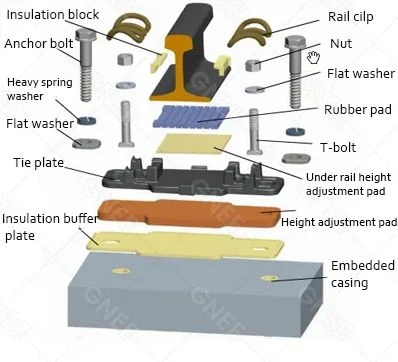
Classification by core components
Spring clip fasteners: With spring clips as the core buckling parts, it is the most common type. Different types of spring clips (such as spring clip type Ⅰ, type Ⅱ, type Ⅲ) have different performances and are used from early ordinary railways to modern high-speed and heavy-duty railways.

Buckle plate fasteners: Buckle the rails with buckles and fasten with bolts. It was widely used in railway construction in the past, and is now gradually replaced by spring clip fasteners, but it is still used in some special scenarios.

Application scenarios and key roles
On high-speed railways, fasteners need to have high elasticity, high buckle pressure and excellent fatigue resistance to cope with high-frequency vibration and impact of train speeds above 300km/h; fasteners on heavy-duty railways have to withstand the huge axle weight of 10,000-ton trains, and have extremely high requirements for strength and durability; fasteners for urban rail transit pay more attention to vibration reduction and noise reduction to reduce the impact on the surrounding environment.


Regardless of the scenario, railway fasteners are the core elements to ensure the stability of track geometry and safe operation of trains.