


Steel rails are the load bearing and guiding elements in a railway or tramway track. Individual fragments are bolted or welded together forming a continuous line that supports railcar wheels. The cross section of the rail segment, or the profile, has varied over time and by application area.
What are the weight and length of the Railroad Track?
The weight of a railroad track is measured over a particular length. It is described as pounds per yard or kilograms per meter. The pounds-per-yard figure is almost exactly double the kilograms-per-metre figure. (i.e. 115RE rail is 115 lb/yd which is 57kg/m). The weight of track is an important factor that reflects the strength of that track. Generally speaking, the more rail weights, the more strength a rail has.
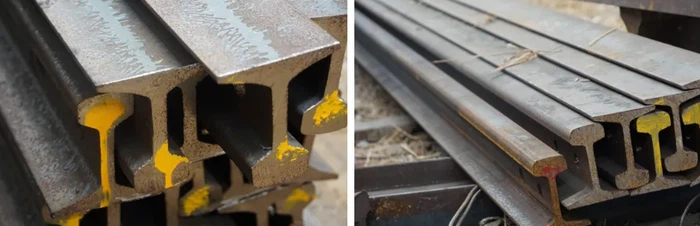
How much does railroad track weigh?
| Country/ Region | Railroad Rail Weight |
|---|---|
| USA | AREA Rail 115(57kg/m), 119(60kg/m), 132(65kg/m), 133(66kg/m) 136(68kg/m), 147(73kg/m) |
| Germany | 54kg/m, 60kg/m |
| France | 54kg/m, 60kg/m |
| Russia | 50kg/m, 65kg/m, 75kg/m |
| Australia | 31kg/m, 41kg/m, 47kg/m, 50kg/m, 60kg/m, 66kg/m, 68kg/m, 73kg/m, 86kg/m, 89kg/m |
| China | 9kg/m, 12kg/m, 15kg/m, 18kg/m, 22kg/m, 30kg/m,43kg/m, 50kg/m, 60kg/m,75kg/m |
| Japan | 30kg/m, 37 kg/m, 40 kg/m, 50 kg/m, 60 kg/m |
Length of railway track
| Country/ Region | Railroad Rail Length |
|---|---|
| USA | 39ft (12m), 78ft (24m), 82ft (25m) |
| Germany | 36m, 120m |
| France | 36m, 75(76)m |
| Russia | 12.5m, 25m, |
| China | 12.5m, 25m, 50m, 100m |
| Japan | 25m, 50m |
How to choose the right steel rail length and weight?
Choosing the right steel rail involves matching its weight (kg/m) to the axle load, train speed, and traffic volume, with heavier rails for high-speed/heavy-haul lines (e.g., 60kg/m+) and lighter for industrial/light-duty use (e.g., 9-30kg/m). Rail length is determined by regional standards (common lengths 25m, 50m, or 12m) and application, balancing transport/installation costs with track smoothness, with longer continuous welded rails (CWR) offering better performance but requiring more precise installation.
Choosing Rail Weight (kg/m)
- Axle Load & Traffic Volume: The primary driver. Higher axle loads (heavy freight, mining) and more tonnage require heavier rails (e.g., 75kg/m) for stability and to prevent crushing/fatigue.
- Operating Speed: High-speed passenger lines need strong, smooth rails (e.g., 60kg/m+) for stability and comfort, resisting vibration and impact.
- Application: Mainlines use heavy rails; subways, industrial sidings, or light railways use lighter rails (e.g., 9-30kg/m).
- Wear Resistance: Small-radius curves or severe conditions may need heat-treated or alloy steel (like U75V) for better wear and fatigue life.

Choosing Rail Length
- Standard Lengths: Common lengths include 25m (USA, Russia, China), 50m (China, Japan), 39ft (USA), 36m (Europe).
- Continuous Welded Rail (CWR): Longer lengths (or welded sections) provide smoother rides, reduced joints, and lower maintenance for high-speed/heavy-haul lines but demand precise installation and temperature management.
- Installation & Transport: Shorter lengths are easier to transport and install but create more joints, increasing wear and vibration.
Since 2008, GNEE RAILWAY RAILWAY has been supplying steel rails of different grades for more than 18 years, steel rails from GNEE RAILWAY is highly recommened in China and abroad.Wtih cutting edge equipment, GNEE RAILWAY produces high quality steel rails that meet with requirements of most countries. Standard rail, head hardened rail, heavy rail,light rail,crane rail and other types are all available here, as one of the China main rail supplier, GNEE RAILWAY RAILWAY has been working on supplying economical green railway products all over the world.