


A rail fish plate is a structural joint element designed to re-establish mechanical continuity at rail connections by transmitting bending moments and shear forces through bolted interfaces, extending the service life of jointed track. GNEE RAILWAY RAILWAY provides fish plates for all major international rail standards including GB 8–60 kg/m, UIC50/54/60, DIN536 A55–A120, QU70–QU120, JIS rails, AS1085 rails, BS11 sections, and AREMA/ASCE rails, along with comprehensive rail joint supply and technical support services.

| Standard | Type | Length/Diameter | Weight /Material | |
| AREMA 2007 | 115RE | 4 hole-24" | 17.04Kg | 45# chemical |
| 115RE | 6 hole-36" | 25.56Kg | composition(%): | |
| 132-136RE | 4 hole-24" | 17.75Kg | C: 0.42-0.50 | |
| 132-136RE | 6 hole-36" | 26.63Kg | Mn: 0.50-0.80 | |
| UIC864 | UIC60 | 4 hole-630/Φ26 | 18.07Kg | Si: 0.17-0.37 |
| UIC60 | 4 hole-600/Φ28 | 17.47Kg | Cr: ≤0.25 | |
| UIC60 | 4 hole-630/Φ25 | 18.1Kg | P: ≤0.035 | |
| UIC54 | 4 hole | 14.34Kg | S: ≤0.035 | |
| UIC54 | 6 hole-800 | 19.94Kg | ||
| BS 47-1 | BS75R | 4 hole | 6.56Kg | |
| BS60A | 4 hole | 5.61Kg | ||
| BS80A | 4 hole | 6.5Kg | ||
| BS90A | 685.8/Φ26 | 13.23Kg | 50# chemical | |
| BS90A | 792.9/Φ26.2 | 15.34Kg | composition(%): | |
| BS100A | 4 hole | C: 0.62-0.70 | ||
| 90/91LB | 4 hole | 18.08Kg | Mn: 0.50-0.80 | |
| 90/91LB | 6 hole | 19.9Kg | Si: 0.17-0.37 | |
| AS | 50kg | 4 hole | 14.3Kg | Cr: ≤0.25 |
| 50kg | 6 hole | 19.5Kg | P: ≤0.035 | |
| S49 | 4 hole | 9.71Kg | S: ≤0.035 | |
What are the different types of joints in railway track?
Railway track joints connect rail ends to provide continuity, categorized by sleeper position (supported, suspended), rail alignment (staggered, square), and function (insulated, compromise, welded). They manage expansion, electrical signaling, and rail size differences, with common types including fish-plated (bolted) joints, insulated joints, and continuous welded rails.
Types of Railway Joints Based on Position & Design
- Supported Joint: The rail ends rest directly on a single sleeper.

- Suspended Joint: The rail ends are suspended between two sleepers, offering better flexibility.
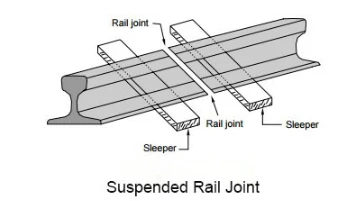
- Bridge Joint: A type of suspended joint where a metal bridge supports the rail ends.
- Staggered Joint: Joints on opposite rails are not opposite each other; used on curves to prevent excessive rocking.
- Square Joint: Joints on opposite rails are directly opposite one another.
Types of Railway Joints Based on Function & Structure

- Ordinary/Bolted Joint: Connects rails of the same profile using fishplates and bolts.
- Insulated Joint: Used in automatic signaling sections to isolate electric circuits, often made of composite materials.
- Compromise Joint: Connects two rails with different profiles, weights, or sections.
- Welded Joint (CWR/LWR): Rail ends are welded to form a continuous, seamless track, eliminating the need for joint maintenance.
- Glued Insulated Joint: A specialized, high-strength insulated joint that is glued rather than just bolted.
- Expansion Joint: Designed to allow for expansion and contraction of the rails, specifically at bridge approaches or in long welded rails.
- Joggled Joint: A temporary repair joint for broken or cracked rails.
| Joint Type | Key Specification / Description |
|---|---|
| Standard Rail Joint (Fish Plate) | - Profile: Matches the rail section (e.g., UIC 60, 136RE). - Length: Typically 600mm or 800mm per side. - Holes: 4 or 6 bolt holes per bar. |
| Insulated Rail Joint (IRJ) | - Material: Steel core with composite insulating end-posts/plates, or full epoxy composite. - Electrical Resistance: >10⁸ Ω. |
| Compromise Rail Joint | - Design: Connects two different rail profiles (e.g., UIC 54 to UIC 60). - Profile: Each side is machined to match its respective rail section. |
| Joggled Rail Joint | - Feature: Has a depressed (joggled) section to allow continuous rail head surface for smoother wheel passage. |
| Bridge Rail Joint | - Design: Often reinforced (thicker web/longer length) for high-stress locations like bridge approaches. |
| Glued Insulated Joint | - Construction: Steel bars bonded to composite insulation using high-strength adhesive for improved durability. |
| Welded Rail Joint (for CWR) | - Type: Flash-butt or thermite weld. - Specification: Weld must meet mechanical properties equal to or greater than the parent rail. |
| Expansion Joint (for BRE) | - Feature: Allows controlled thermal expansion in long rails on bridges or in extreme temperature zones. |
Founded in 2008, GNEE RAILWAY RAILWAY is a leading global manufacturer and supplier of railway components, specializing in high-quality rail fish plates (joint bars/splice bars) with strong production capacity and global service capabilities.
Our rail fish plate portfolio is comprehensive and compliant with international standards including UIC, AREMA, BS, DIN, and GB, covering light rail (8kg-30kg), heavy rail (38kg-75kg), and crane rail (QU70-QU120) systems. We offer diverse types such as insulated joint bars, bulged fish plates, and compromise rail joints,with precise specifications (4-hole/6-hole, 24-inch/36-inch), ensuring excellent mechanical performance.We uphold strict quality control supported by ISO 9001:2015 certification, an in-house inspection center, and third-party audits by SGS and BV. Our one-stop service includes customization, production, packaging, and after-sales support, tailored to clients' project needs.