


The Influence of Gauge Block Material Hardness on Fastening System Compatibility
Q1: What are the main problems caused by excessively low hardness of gauge blocks?
A1: Low hardness causes rapid compression deformation of gauge blocks under lateral force, leading to gradual gauge widening. Poor material wear resistance results in severe working surface wear, requiring replacement in a short time. At the same time, unstable support leads to eccentric clip stress and aggravated fatigue damage.
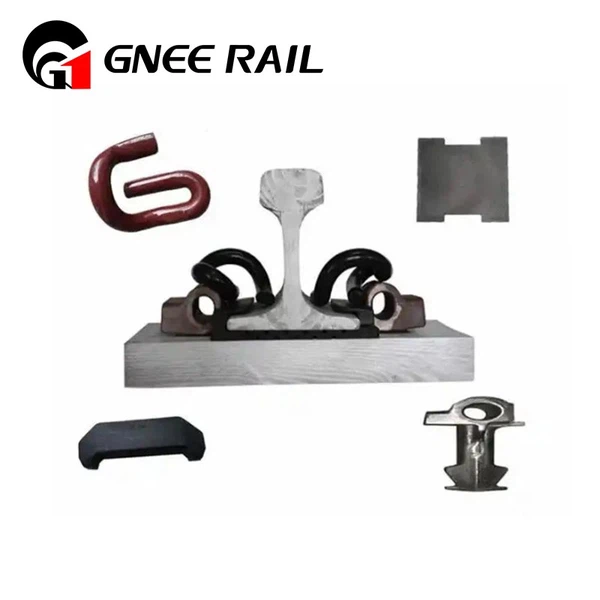
Q2: Why is excessively high hardness of gauge blocks also detrimental to line stability?
A2: Excessively high hardness increases the brittleness of gauge blocks, reduces impact resistance, and makes them prone to chipping and cracking at positions with strong impact such as joints and curves. At the same time, insufficient elasticity cannot buffer vibration, and stress is directly transmitted to clips and bolts, accelerating component fatigue.

Q3: Why are stricter requirements placed on gauge block hardness in curved sections?
A3: Curves have large lateral forces and strong wear, and gauge blocks need both high wear resistance and certain toughness. Insufficient hardness leads to rapid wear and gauge widening; excessively high hardness causes brittleness and fragmentation. Only reasonable hardness can ensure long-term stable use.

Q4: How does gauge block hardness affect clip clamping force distribution?
A4: Gauge blocks with moderate hardness provide uniform support, centered clip stress and stable clamping force. Too soft causes local subsidence leading to clip eccentric load; too hard causes stress concentration, both of which deteriorate clip stress distribution and reduce fatigue life.
Q5: How to simply judge whether the gauge block hardness is appropriate on site?
A5: Observe whether obvious wear, indentation or chipping occurs after a period of use. Uniform slight wear is normal; rapid thinning, deformation or spalling indicates unreasonable hardness. Comparing components of the same batch, large wear difference also indicates unstable material.