


A steel rail is a high-precision steel component that supports rolling vehicles, controls track gauge, and distributes dynamic and static loads to the sleepers and subgrade. Its design ensures operational safety and longevity under heavy use. GNEE RAILWAY RAILWAY provides all-standard rails, including GB 8–60 kg, UIC50–UIC60, DIN536 A55–A120, QU70–QU120, JIS 15KG–CR100, AS1085 31–89 kg, BS11:1985, and AREMA/ASCE 25–175 lb, along with technical support for installation, welding, surface treatment, and project-specific layout planning.
What are the functions of rails in railway?
In a railway system, rails are the primary load-bearing and guidance components of the track structure, and their functions go far beyond simply providing a surface for wheels to roll on. From an engineering perspective, rails perform several critical mechanical and operational roles that directly affect safety, stability, and service life of the entire track system.
- First, rails support and distribute wheel loads from trains to the sleepers (ties) and then to the ballast or slab foundation. Modern trains impose very high axle loads and dynamic impacts, especially on curves, switches, and braking zones. The rail's cross-section and steel grade are designed to resist bending stress, contact stress, and fatigue, ensuring that vertical loads are spread over a larger area and do not cause excessive deformation of the track structure.
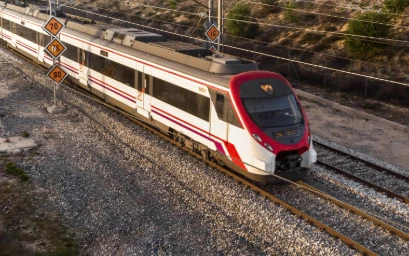
- Second, rails provide precise guidance for train wheels and maintain the correct gauge. The wheel flange runs along the rail head profile, and the rail geometry ensures that vehicles remain centered on the track, even at high speed and through curves. Any deviation in rail alignment or profile can directly affect ride stability, wheel wear, and derailment risk, which is why rail straightness, head shape, and fastening stiffness are tightly controlled in standards.
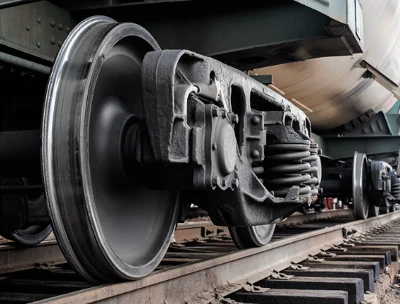
- Third, rails offer a smooth, low-resistance running surface, which is essential for energy efficiency and passenger comfort. A well-maintained rail head reduces rolling resistance, vibration, and noise. This is particularly important on high-speed and urban passenger lines, where surface defects can lead to corrugation, noise pollution, and accelerated wheel and rail wear if not controlled through grinding and material selection.
Steel Rail Types
The type of rail is classified by kilograms per meter of rail length. For example, steel rails used in China's railways are 75kg/m, 60kg/m, 50kg/m, 43kg/m and 38kg/m.
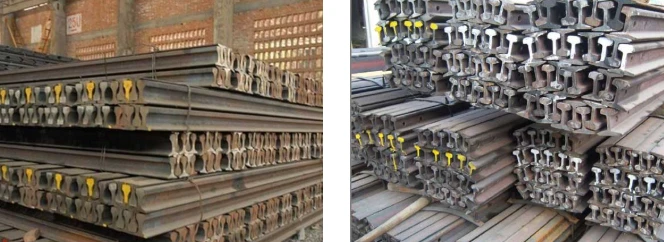
- Classified by Application: GNEE RAILWAY RAILWAY supplies crane rail( QU120,QU100,QU80,QU70), heavy rail( 38, 43, 50, 60, 75kg) and light rail( 9,12,15,22,30kg/m).
| Classification | Height(mm) | Head (mm) | Bottom (mm) | Thick(mm) | Weight (kg/m) | |
| Light Rail | 8 KG/M | 65 | 25 | 54 | 7 | 8.42 |
| 9 KG/M | 63.5 | 32.1 | 63.5 | 5.9 | 8.94 | |
| 12 KG/M | 69.85 | 38.1 | 69.85 | 7.54 | 12.2 | |
| 15 KG/M | 79.37 | 42.86 | 79.37 | 8.33 | 15.2 | |
| 18 KG/M | 80 | 40 | 80 | 10 | 18.06 | |
| 22 KG/M | 93.66 | 50.8 | 93.66 | 10.72 | 22.3 | |
| 24 KG/M | 107 | 51 | 90 | 10.9 | 24.46 | |
| 30 KG/M | 107.95 | 60.33 | 107.95 | 12.3 | 30.1 | |
| Heavy Rail | 38 KG/M | 134 | 68 | 114 | 13 | 38.733 |
| 43 KG/M | 140 | 70 | 114 | 14.5 | 44.653 | |
| 45 KG/M | 145 | 67 | 126 | 14.5 | 45.546 | |
| 50 KG/M | 152 | 70 | 132 | 15.5 | 51.514 | |
| 60 KG/M | 176 | 73 | 150 | 16.5 | 60.64 | |
| Crane Rail | QU 70 | 120 | 70 | 120 | 28 | 52.8 |
| QU 80 | 130 | 80 | 130 | 32 | 63.69 | |
| QU 100 | 150 | 100 | 150 | 38 | 88.96 | |
| QU 120 | 170 | 120 | 170 | 44 | 118.1 | |
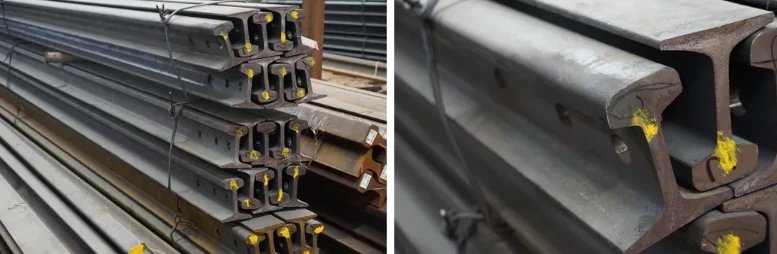
- Stee rail in foreign standards: British Standard: BS series (90A, 80A, 75A, 75R, 60A, etc.) German standard: DIN series crane rails. International Railway Union: UIC series. American Standard: ASCE series. Japanese standard: JIS series
| Standard | Sepc. | Material Typical Grade |
| UIC860 | UIC54 | 700,900A,900B |
| UIC60 | ||
| EN13674.1 | 5.00E+02 | R200,R350HT,R260Mn,R35LHT,R320Cr,R370CrHT |
| 5.40E+02 | ||
| 6.00E+02 | ||
| 6.00E+03 | ||
| BS-11-1985 | BS80A | 700,900A,900B |
| BS90A | ||
| BS100A | ||
| AREMA | 115RE | SS,HH,LA,IH |
| 136RE | ||
| ASCE60 | U71Mn | |
| ASCE85 | U71Mn |
As a professional rail fastener supplier, GNEE RAILWAY RAILWAY can provide different standard steel rail such as GB,American, BS, UIC, DIN, JIS, Australian and South Africa which used in railway lines, cranes and coal mining.