


Key Differences Between Chinese and International Rail Standards
What are the differences in material requirements between national standard rails and international standard rails?
National standard rails mainly adopt hot-rolled steel of specific strength grades, and the chemical composition must meet the content standards of manganese, silicon and other elements specified in GB/T2585. International standard rails, such as those meeting EN standards, have stricter control over the impurity content of steel, and some require adding alloy elements such as chromium and nickel. National standards focus on adapting to the load characteristics of domestic railway transportation, while international standards pay more attention to durability in various climatic environments. Material differences lead to different welding process requirements for the two types of rails, and the welding of national standard rails must comply with TB/T1632. This difference also makes national standard rails more widely used in domestic trunk railways, while international standards are common in cross-border railways or foreign-funded projects.

What are the differences in dimensional accuracy requirements between national standard rails and international standard rails?
National standard rails have clear regulations on the tolerance range of key dimensions such as rail head width and rail web thickness, and the allowable deviation is suitable for the processing capacity of domestic manufacturing equipment. International standard rails, such as those meeting ASTM standards, have more precise dimensional tolerance control, especially higher requirements for rail base flatness. The length specifications of national standard rails are mostly 12.5 meters or 25 meters, while international standards have special lengths such as 11.89 meters to adapt to foreign laying habits. Dimensional accuracy differences mean the two cannot be directly interchanged and need to be matched with corresponding sleepers and fasteners. This difference in requirements also stems from the different design standards and load-bearing needs of railway tracks in different countries.
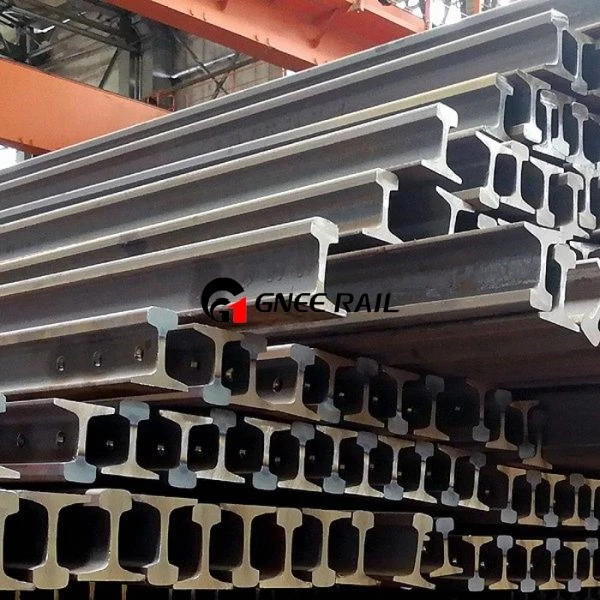
What are the differences in application scenarios between national standard rails and international standard rails?
National standard rails are mainly used in domestic conventional speed railways, high-speed railways and urban rail transit lines, adapting to the wheel-rail parameters of domestically independently developed locomotives and rolling stock. International standard rails are common in cross-border railways, international cooperation projects and some dedicated lines built by foreign capital, needing to match the wheel set dimensions of foreign locomotives. National standard rails have been targeted optimized for adaptability in alpine and high-altitude areas, while international standards pay more attention to corrosion resistance in coastal humid environments. For heavy-haul railways, national standards have special high-strength rail models, while international standards classify load levels according to standards such as EN 13674-1. Differences in application scenarios also determine different procurement and acceptance processes for the two, with international standards requiring additional compliance with import inspection standards.

What are the differences in quality inspection items between national standard rails and international standard rails?
Inspection of national standard rails must cover five categories: appearance quality, dimensional accuracy, chemical composition, mechanical properties and internal defects, with internal defect detection mainly using ultrasonic flaw detection. In addition to the above items, international standard rails also need to add fatigue performance testing and corrosion resistance testing, and some standards require magnetic particle flaw detection. National standard inspection is based on domestic standards such as GB/T2585 and TB/T1632, while international standards follow inspection methods specified in international standards such as EN and ASTM. National standards have more detailed inspection requirements for rail welding joints, while international standards pay more attention to the completeness of factory inspection reports for finished rails. Differences in inspection items also lead to certain differences in testing equipment and processes between the two.
What key factors should be considered when purchasing and selecting national standard rails and international standard rails?
When purchasing national standard rails, it is necessary to confirm whether the supplier has domestic railway product certification qualifications to ensure the products meet the quality and safety requirements of the National Railway Administration. When selecting international standard rails, it is necessary to verify whether the products have passed international standard certification and have corresponding import inspection and quarantine certificates. The appropriate standard rail should be selected according to the railway grade, transportation load and environmental conditions of the project. The convenience of subsequent maintenance should be considered; spare parts for national standard rails are more readily available, while for international standards, the inventory cycle needs to be planned in advance. Welding compatibility should also be evaluated to ensure the selected rails can effectively connect with existing tracks or joint components.