


How to install rail rubber pads?
Rail pads are elastic polyurethane mats which are interposed between steel rails and railway sleepers to protect the sleeper top from wearing and impacting.The starting stiffness of a rail pad is designed to not be high so that their relative deformation under the spring clip toe loads is greatly substantial. In this way, it can guarantees the rail pad maintaining in close contact with the rail despite of any vertical movements of the latter. In addition, the reason why rail pads made up of rubber or plastic is to dampen the shocks of vibration of a passing train.
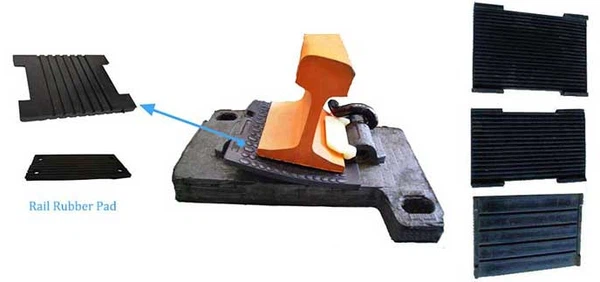
Installing rail rubber pads involves preparing the surface (clean, dry), positioning the pad between the rail and sleeper/support, placing clips or fasteners over it, and tightening to specified torque for vibration dampening, ensuring proper material fit for temperature/environment, especially for heavy-duty tracks or pool tables.
General Rail Pads
- Surface Prep: Ensure the concrete sleeper/support is clean, dry, and free of oil/debris. Preheat pads if below 5°C (41°F) to prevent brittleness.
- Placement: Place the rubber pad onto the prepared support surface, between where the rail will sit.
- Rail & Fasteners: Position the rail on the pad. Place clips, washers, and bolts over the rail flange and through the sleeper.
- Tighten: Secure the clip/fastener by tightening the nuts to the manufacturer's specified torque, ensuring the pad's nose rests correctly.
Functions of Rubber Rail Pads
It is thought that the rubber rail pads act in two main ways: they diminish shock or impact loads by providing compliance, and they can reduce (by isolation and perhaps by damping) resonant vibrations excited in the concrete ties (lowest resonant frequency about 200 Hz) and accommodate vibration deflections in the rail sections between the ties (about 0.12mm amplitude, 1000 Hz). In addition, rubber rail pads can prevent rail sleeper abrasion, and crushing of the sleeper under the rail foot.
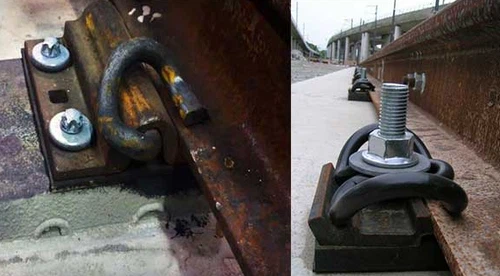
GNEE RAILWAY RAILWAY is a professional railway fasteners manufacturer from China. We can provide different standards rail pad, steel rail, rail clips, railroad spike, screw spike, tie plate, rail bolt and nuts, railway fish plates and etc. based on rich experience and advanced technology, GNEE RAILWAY RAILWAY helps you learn the rail pad fully.
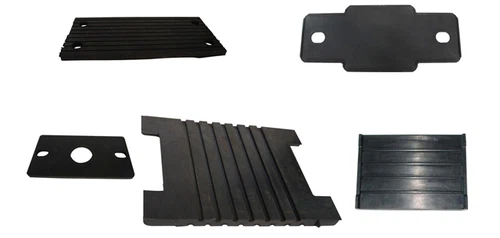
We have developed a range of high-performance elastic rail pads for stiffness requirements and various application areas-from trams through standard gauge railways to heavy haul lines, especially those for E-type rail fastening systems and SKL type rail fastening systems with material of HDPE/EVA/Rubber, with following properties respectively.
| Technical Parameter | Unit | Technical Requirement | Value |
| Density | g/cm3 | 0.95-0.98 | 0.95 |
| Tensile Strength | Mpa | ≥19 | 19 |
| Elongation | % | >80 | 150 |
| Melting Point | ℃ | 170-190 | 190 |
| Insulation Resistance | Ω | ≥1×10¹⁰ | 3.5 ×10¹⁰ |
| Hardness | A | ≥98 | 98(A) |
| Technical Parameter | Unit | Technical Requirement | Value |
| Density | g/cm3 | 0.95-0.98 | 0.95 |
| Tensile Strength | Mpa | ≥15 | 16 |
| Elongation | % | >500 | 550 |
| Melting Point | ℃ | 170-190 | 170 |
| Insulation Resistance | Ω | ≥1×10¹⁰ | 5.0 ×10¹⁰ |
| Hardness | A | ≥90 | 92(A) |
| Technical Parameter | Unit | Value |
| Stiffness | KN | 90-130 |
| Hardness Shore A | ℃ | 72-80 degree |
| Electronic Resistance | Ω | ≥ 106 |
| Tensile Strength before Aging | Mpa | ≥12.5 |
| Elongation before Aging | % | ≥250 |
GNEE RAILWAY RAILWAY is equipped with rail pad production lines for 130sets of machines, for the whole process of injection, refining rubber, sulfuration, moulding and inspection, etc. We own the most engineers for rail pad development, design, production and inspection, with annual production capacity reaching up to 2000, 000 pieces.