


Fishplate Welding Reinforcement and Joint Strength Enhancement
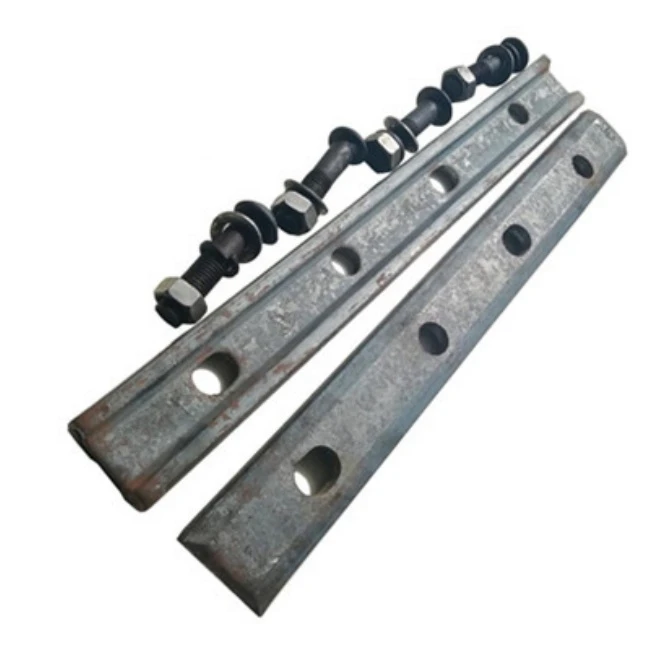
What are the common defects of fish plate joints? How to improve them through welding reinforcement?Common defects of fish plate joints include bolt hole cracks, fish plate wear, and joint loosening, among which bolt hole cracks are the most dangerous. For welding reinforcement, cracks must first be cleaned, then the crack area filled by shielded metal arc welding using electrodes (e.g., J507) matching the fish plate material. Fillet welding reinforcement around bolt holes increases local thickness and improves crack resistance. Post-welding heat treatment eliminates welding stress to avoid new cracks. Reinforced fish plate joints have over 20% higher strength, effectively extending service life. However, welding reinforcement only applies to minor defects; severe cracks require fish plate replacement.
What are the differences in welding processes for fish plates of different materials?
Carbon steel fish plates (e.g., Q235) have simple welding processes, using shielded metal arc welding with 100-120A current and moderate welding speed. Alloy steel fish plates (e.g., 45# steel) require preheating to 150-200℃ before welding to prevent welding cracks. Stainless steel fish plates use special stainless steel electrodes with low-current, high-speed welding to avoid intergranular corrosion. Groove designs vary: V-grooves for carbon steel and U-grooves for alloy steel to ensure full penetration. Cooling methods differ too-carbon steel cools naturally, while alloy steel requires slow cooling to reduce stress.
What special requirements apply to welding reinforcement of fish plates for heavy-haul railways?
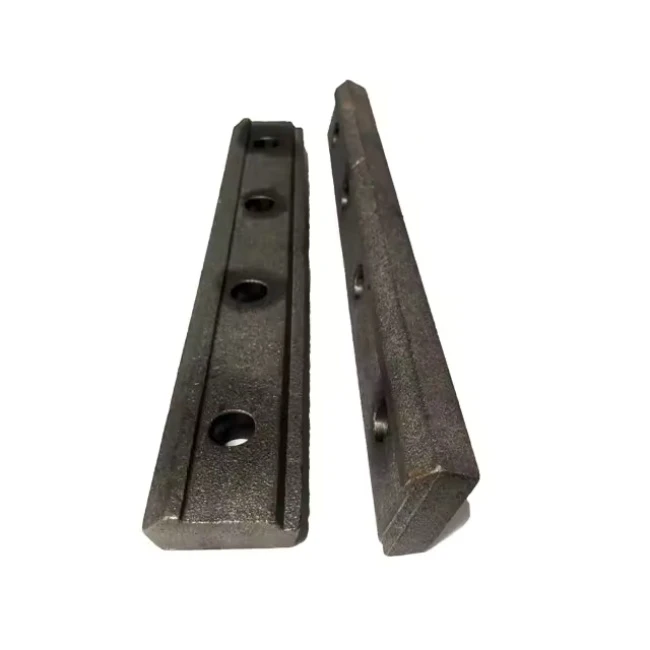
Heavy-haul railway fish plates bear large loads, so welding reinforcement uses high-strength electrodes to ensure weld tensile strength matches the base metal. Comprehensive flaw detection is performed before welding to identify all hidden cracks. Multi-layer, multi-pass welding is adopted, with each layer 3-5mm thick to avoid stress concentration from excessive single-layer thickness. Post-welding ultrasonic flaw detection ensures no internal weld defects. Reinforced fish plates undergo load tests to verify joint capacity meets heavy-haul requirements. Welding reinforcement must be conducted by professionals to strictly control quality.

How to ensure the smoothness of welded joints between fish plates and rails?
Before welding, adjust alignment accuracy-top and side flush deviation ≤0.3mm. Grind the weld area to be flush with the rail surface using grinders for smooth wheel-rail transition. Control weld height to not exceed 0.5mm above the rail surface to avoid steps. Precision grind the weld and surrounding areas post-welding to achieve Ra≤1.6μm roughness. Surfacing welding is used in some scenarios to precisely control weld shape and ensure smoothness. Joint smoothness directly affects wheel-rail contact; uneven joints intensify wear and vibration.
How to conduct quality inspection of welded and reinforced fish plates?
Visual inspection is fundamental-check for uniform weld formation without porosity, slag inclusion, or cracks. Magnetic particle inspection detects surface and near-surface weld cracks to eliminate hidden defects. Ultrasonic flaw detection inspects internal weld quality for incomplete penetration or internal cracks. Mechanical property tests include tensile tests for weld strength and impact tests for low-temperature toughness. Finally, on-site load tests simulate train passage to verify stable joint performance. Only qualified products are put into use; unqualified ones require re-reinforcement or replacement.