


Fishplate Toothed Engagement Design and Rail Joint Stiffness Matching Technology
What are the joint connection differences between the toothed bite design and the flat joint design of fish plates?
The core differences between the toothed bite design and the flat joint design of fish plates are reflected in three aspects: connection mode, stiffness transmission and anti-displacement capacity. The toothed design fundamentally improves the connection stability of rail joints. The flat joint fish plate is connected with the rail through plane fitting, relying only on the friction force generated by bolt pre-tightening force. The fitting surface is prone to slipping due to vibration, leading to transverse and longitudinal displacement of the rail joint and affecting line smoothness. The toothed bite design processes trapezoidal teeth on the fitting surface of the fish plate and the rail, with the tooth pitch and tooth depth accurately matching the cross-sectional size at the rail joint. After installation, the teeth are interlocked to form a dual connection of mechanical bite + friction force, completely eliminating rail displacement. In terms of stiffness transmission, the joint stiffness of the flat joint design is only 60%-70% of the rail base material, and joint settlement is prone to occur when the train passes. While the toothed bite design realizes continuous stiffness transmission through the rigid interlock of teeth, making the joint stiffness reach more than 90% of the rail base material and reducing stress mutation at the joint. In addition, the contact area of the fitting surface of the toothed bite design is 30% larger than that of the flat joint design, the effect of bolt pre-tightening force is more uniform, avoiding rail joint deformation caused by excessive local pressure, while the flat joint design has a small contact area and is prone to fitting surface wear.

What are the core structural parameters of the toothed bite design of fish plates?
The core structural parameters of the toothed bite design of fish plates include tooth type, tooth pitch, tooth depth, and fitting surface roughness. The four parameters jointly determine the bite effect and joint stiffness, and must be strictly designed to match the rail type. The trapezoidal tooth is selected as the tooth type. Compared with triangular teeth and arc teeth, the bite surface of trapezoidal teeth is a plane, with stronger shear resistance and not prone to tooth deformation, adapting to the stress characteristics of rail joints, and is the most widely used tooth type at present. The tooth pitch is adjusted according to the rail type, with 8-10mm for 60kg/m rail and 6-8mm for 50kg/m rail. Excessively large tooth pitch results in insufficient bite points and poor connection stability, while excessively small tooth pitch increases processing difficulty and is prone to tooth chipping. The tooth depth is controlled at 2-3mm, taking the upper limit of 3mm for 60kg/m rail and the lower limit of 2mm for 50kg/m rail. Excessively deep teeth will weaken the cross-sectional strength of the fish plate and rail, while excessively shallow teeth cannot form effective bite and fail to prevent displacement. The fitting surface roughness must be controlled at Ra1.6-Ra3.2μm. Excessively high roughness leads to loose tooth fitting and gaps, reducing the bite effect; excessively low roughness reduces friction and affects the auxiliary connection effect, which must be guaranteed by precision grinding. In addition, the inclination angle of the teeth is uniformly 45° to ensure uniform stress during biting and avoid unilateral stress concentration.

What are the stiffness matching requirements of fish plates for 60kg/m and 50kg/m rails?
The core of stiffness matching of fish plates for 60kg/m and 50kg/m rails is to adjust the plate thickness, number of bolt holes and material strength of the fish plate to match the joint stiffness with the rail base material stiffness and avoid stress concentration caused by stiffness mutation. The 60kg/m rail base material has high stiffness, mainly used in high-speed and heavy-haul lines with higher requirements for joint stiffness. The adapted fish plate is made of Q345B high-strength steel with a thickness of 16-18mm, 2-3mm thicker than that for 50kg/m rail. The self-stiffness is improved by increasing the plate thickness, and the number of bolt holes is 8, evenly distributed on both sides of the plate body to expand the scope of pre-tightening force, making the joint stiffness reach more than 95% of the rail base material and meeting the stiffness transmission requirements of high-speed and heavy-haul lines. The 50kg/m rail base material has moderate stiffness, mainly used in ordinary-speed and station yard lines. The adapted fish plate is made of Q235B steel with a thickness of 14-16mm and 6 bolt holes, and the joint stiffness is controlled at 90%-95% of the rail base material, reducing processing and material costs on the basis of ensuring connection stability. Both types of fish plates must ensure "stiffness gradient", the plate body adopts a slightly gradient thickness from both ends to the middle, the middle joint is the thickest, and gradually thins to both ends, making the joint stiffness transition smoothly from the fish plate to the rail base material without obvious mutation. In addition, the bolt pre-tightening force of the fish plate for 60kg/m rail should be controlled at 450-500N·m, and 350-400N·m for 50kg/m rail, the pre-tightening force is matched with the plate thickness and stiffness to avoid deformation of the fish plate or rail caused by excessive pre-tightening force.
What are the anti-corrosion sealing design of fish plates and the anti-seepage requirements of rail joints?
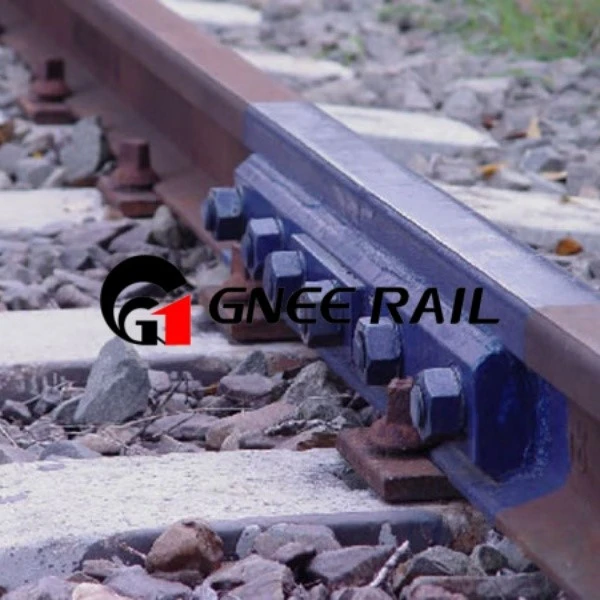
The core of the anti-corrosion sealing design of fish plates is to realize the self-corrosion protection of the fish plate and the anti-seepage of the rail joint through surface anti-corrosion treatment + joint sealing structure, avoiding joint corrosion caused by the intrusion of water and corrosive media. The surface anti-corrosion of the fish plate adopts a composite process of hot-dip galvanizing + closed coating, the galvanized layer thickness is 80-100μm, protecting the plate body through the sacrificial anode effect, and the closed coating thickness is 10-15μm, isolating the galvanized layer from contact with external media to prevent zinc layer oxidation. The neutral salt spray test can reach more than 800h without red rust, adapting to different corrosive environments such as inland and coastal areas. The joint anti-seepage design adopts special sealing rubber strips + bolt hole sealing rings. The sealing rubber strip is made of nitrile rubber, attached to both sides of the fitting surface of the fish plate and the rail, and is extruded and deformed after installation to fill the gap of the fitting surface and prevent water and debris from intruding; the bolt hole sealing ring is a rubber ring, sleeved on the bolt, and closely attached to the inner wall of the bolt hole and the surface of the fish plate after installation to realize the sealing of the bolt hole and avoid water from infiltrating into the rail joint from the bolt hole. In addition, the edges of both ends of the fish plate adopt arc flanging design to prevent the sealing rubber strip from being extruded and falling off, and anti-corrosion sealant is applied at the flanging to further improve the sealing effect. For lines in coastal high-salt spray and rainy areas, a plastic protective cover can be installed on the outside of the joint to form a double seal and completely prevent the intrusion of corrosive media.
What are the key points of on-site installation of fish plates and joint gap control?
The core of on-site installation of fish plates and joint gap control is to ensure accurate tooth bite, qualified bolt pre-tightening force and uniform rail joint gap, avoiding connection failure caused by improper installation. Before installation, clean the rust and debris on the rail joint and the fitting surface of the fish plate, check whether the teeth are intact, only fish plates without deformation and chipping can be used, and check the straightness of the rail joint at the same time, the deviation of height and left-right misalignment ≤0.2mm, otherwise the rail must be straightened first. During installation, accurately align the teeth of the fish plate with the teeth of the rail joint to ensure full tooth bite without local virtual connection, the fish plates on both sides must be installed synchronously to avoid rail offset caused by unilateral stress. Bolt installation adopts diagonal tightening method, tightening from the middle to both ends in turn, completing pre-tightening in three times, tightening to 1/3 of the pre-tightening force each time to avoid plate deformation caused by one-time tightening. Finally, the bolt pre-tightening force of 60kg/m rail reaches 450-500N·m, and that of 50kg/m rail reaches 350-400N·m. The gap of the rail joint must be strictly controlled, the gap is 2-4mm at room temperature (20-25℃), taking the upper limit of 4mm in high-temperature areas and the lower limit of 2mm in low-temperature areas, reserving space for thermal expansion and contraction to avoid joint deformation caused by rail temperature stress, the gap deviation ≤±0.5mm, detected by a special feeler gauge. After installation, check whether the sealing rubber strip at the joint is closely attached without falling off and gaps, and whether the bolt hole sealing ring is installed in place to ensure the anti-seepage effect.