


Both Type I and Type II fastening systems secure rails to sleepers and maintain track stability, but they differ significantly in multiple aspects.
1. Component Design
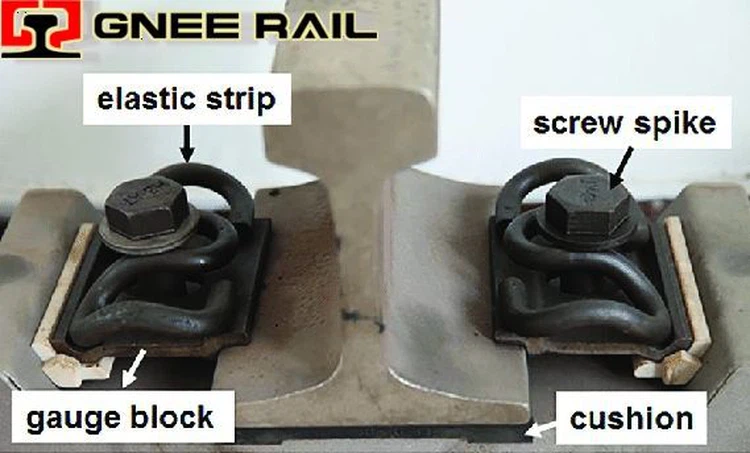
While sharing basic components (elastic clips, spiral spikes, gauge retainers, rubber pads), their details vary:
Elastic Clips:
Type I: ω-shaped, made of ordinary spring steel.
Type II: Uses 60Si2CrVA premium spring steel, with yield strength +42% and tensile strength +36% higher than Type I.
Gauge Retainers:
For 50kg/m rails, Type I has middle/rejoint retainers in sizes 14/20.
Type II may differ in dimensions and size configurations due to design adjustments.
2. Working Principles
Type I: Generates clamping force via elastic deformation of ω-shaped clips.
Type II: Upgraded material and clip design offer:
10kN clamping force per clip (vs. Type I's 8.2kN initial force)
10mm stroke (vs. 8mm in Type I)
This provides stronger resistance to train forces and better gauge stability.
3. Performance Characteristics
Type I:
Suits standard-gauge rails (50/60kg/m) on curves ≥300m radius.
Widely used in ordinary railways but lacks durability in heavy-haul or high-speed scenarios.
Type II:
Optimized for 60kg/m rails and pre-stressed concrete sleepers.
Excels in heavy-haul railways and speed-up lines due to higher stability and clamping force.
| Fastening type | Type I Rail Clip | Type I Rail Clip adjusted | Type II Rail Clip | ||
| Application conditions | <120 km/h | 120~200 km/h | Application conditions | ||
| Conventional resistance section | |||||
| Standard | TB/T 1495 | TB 1911 | TB/T 3065 | ||
| Applicable Rail Sleeper Type | Type I and II concrete shoulders | Type Ⅲ concrete shoulders | |||
| Rail Clip | Type | Type A | Type B | Type A | Type II |
| Clamping force | 8 kN | 9 kN | 8 kN | 10 kN | |
| Stretch range | 9 mm | 8 mm | 9 mm | 10 mm | |
| Fastening method | Rail Bolt Fasten | ||||
| Tightening torque | About 80 to 120 N.m about 120 to 150 N.m (small radius section) | about 100~140 N.m | |||
| Rail longitudinal resistance | >7.5 kN | >9 kN | |||
| Rail Pad | Set | Single-layer rubber rail pad between rail and sleeper | |||
| Model | 60-10-11 | 60-10-17 60-12-17 | |||
| Size | 185×149×10 | 190×149×10(12) | |||
| 90~120 kN/mm | 55~80 kN/mm | ||||
| Standard | TB/T2626 | ||||
| Steel Rail Height | Rail surface height | 186mm | |||
| 10 mm | 20 mm | 10 mm | |||
| Adjust position | Under the rails, adjust rail pad height | ||||
| gauge | adjust amount | -8~+12 mm | -12~+8 mm | ||
| adjust method | Adjust by replacing different numbers of gauge and baffle seats | ||||
| adjust level | 2mm | ||||
4. Maintenance Needs
Type I: Requires more frequent inspections and replacements due to lower component strength, leading to higher maintenance costs.
Type II: Longer lifespan and fewer maintenance needs thanks to upgraded materials and design.

In summary, Type II represents an improvement over Type I, offering clear advantages in materials, performance, and application to meet evolving rail transport demands.
GNEE RAILWAY RAILWAY is a professional company focusing on international trade of railway fasteners, mainly supplying various types of rail fasteners, connecting bolts, elastic gaskets and other products. We have a stable production base and a professional quality inspection team to ensure that each batch of products meets international railway industry standards. After years of development, we have established a complete export service system, which can provide customers with full-process services from product selection, quality control to logistics and transportation.