


The railway fasteners used in ballastless tracks and ballasted tracks are not identical due to significant differences in load-bearing mechanisms, support conditions, and maintenance requirements between these two track structures.
Ballasted tracks rely on crushed stone ballast to distribute train loads and absorb vibrations, so their fastening systems emphasize connection strength and flexibility with sleepers, typically employing elastic rail clips (such as SKL, KPO, Nabla, E Clip, Fast Clip models), screw spikes, dog spikes, clamping plates, and gauge rods. These fastener systems provide excellent elasticity and maintainability, adapting to potential settlement and displacement of ballast during long-term operation.

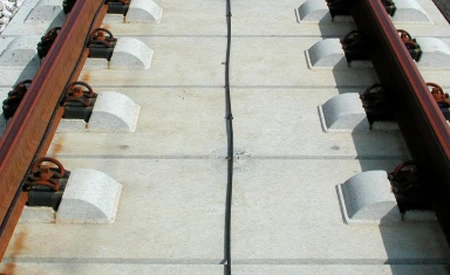
Ballastless tracks, however, directly fix rails to concrete sleepers or track slabs with minimal track elasticity, causing train loads and impacts to be transmitted directly between the slab and rail. Consequently, they require fastening systems with higher elasticity and damping performance. Ballastless tracks commonly use fasteners with high-elasticity rubber pads, thickened insulation sleeves, anti-loosening bolts, and specialized rail support structures to absorb impacts, reduce noise, and extend rail service life. The clip stiffness, fastening pressure, and insulation properties of these systems also differ from those used in ballasted tracks.
GNEE RAIL provides tailored fastening solutions for both ballasted and ballastless tracks, including various elastic rail clips (SKL, KPO, Nabla, E Clip, Fast Clip, etc.), screw spikes, dog spikes, rail pads, gauge rods, fishplates, fish bolts, and insulated gauge blocks. Custom production is available to meet different track structures and operating conditions, ensuring system safety, stability, and durability. Contact GNEE for a free quotation.