


As a key component of high-speed rail tracks, the manufacturing process of the WJ-8 railway fastener system directly affects product performance and high-speed rail operation safety, mainly covering the following core links.
Raw material screening and pretreatment
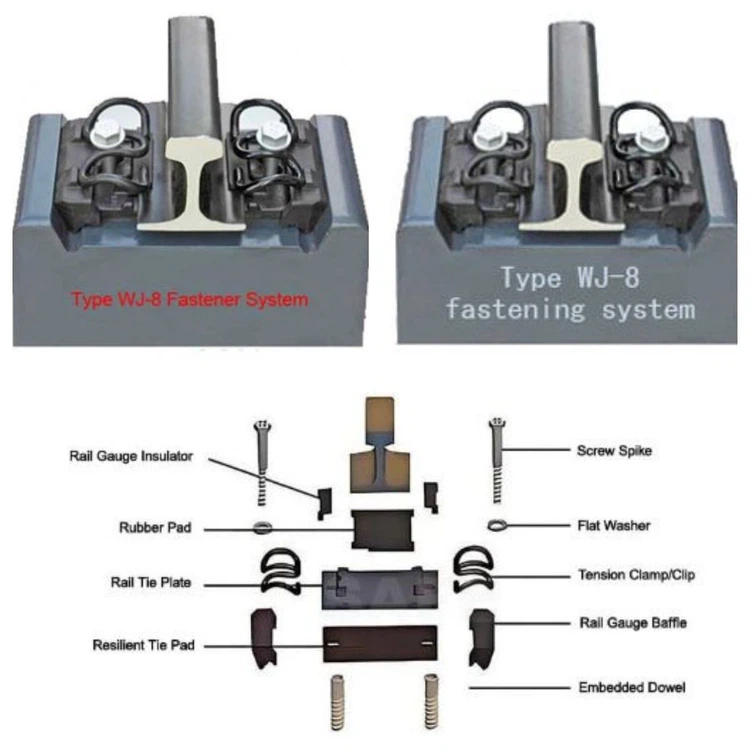
The first step in producing the WJ-8 system is to strictly screen the raw materials. Core components such as spring bars are mostly made of high-strength spring steel such as 60Si2CrA. This steel must have good elasticity, toughness and fatigue strength. Before production, the chemical composition and mechanical properties of the steel must be tested to ensure compliance with the standards. For the engineering plastics and rubber materials used in components such as insulating gauge blocks and rail pads, their insulation properties, aging resistance and compressive strength must be tested. After the raw materials are qualified, they must be pretreated, such as surface rust removal and straightening of steel to ensure subsequent processing accuracy and quality.
| Specifications for ONE unit of WJ-8 Rail Fastening system | ||
| Item | Quantity | Material |
| Rail clip | 2 | 60Si2MnA |
| Screw spike | 2 | 20MnTiB |
| Flat washer | 2 | Q235A |
| Rail Insulator | 2 | PA66 |
| Guide plate | 2 | Reinforced Nylon 66 (PA66) |
| Rail pad | 1 | EVA, or rubber |
| Tie plate | 1 | QT450-10 |
| Plastic dowel | 2 | HDPE, Reinforced Nylon 66 (PA66) |
| Rail Adjustable Pad | 2 | PE |
| Tie Plate adjustable pad | 2 | PE |
Processing and manufacturing of core components
The processing technology of different components has its own characteristics. The manufacturing of spring bars adopts hot forming or cold forming process. Hot forming requires heating the steel to a suitable temperature, stamping it through a mold, and then quenching and tempering it to improve hardness and elasticity; cold forming directly bends and twists the steel at room temperature, and then performs aging treatment to eliminate internal stress after forming. The spiral spike is created by forging process, and then machined to ensure the thread accuracy. In order to ensure the good fit between the thread and the embedded casing, the thread tolerance control is extremely strict. Metal parts such as gauge baffles are produced by casting or stamping process. Casting can manufacture parts with complex shapes, while stamping is suitable for mass production of regular shape parts. After production, surface treatment such as grinding and polishing is required to prevent burrs from affecting use.
Component assembly and quality inspection
After the processing of each component is completed, it enters the assembly stage. According to the design requirements, the spiral spikes, spring bars, insulating gauge blocks and other components are installed on the iron pad in sequence to ensure accurate installation positions and tight connections. After assembly, a comprehensive quality inspection is required. Appearance inspection checks whether there are cracks, deformations, surface defects, etc. on the parts; size inspection uses tools such as calipers and micrometers to measure whether key dimensions such as spring clip diameter and gauge baffle specifications meet the standards; mechanical performance inspection uses special equipment to test spring clip buckle pressure, spiral spike tensile strength and other indicators; insulation performance inspection conducts resistance tests on components such as insulating gauge blocks to ensure that they meet the insulation requirements of high-speed rail track circuits.
Surface treatment and packaging before delivery
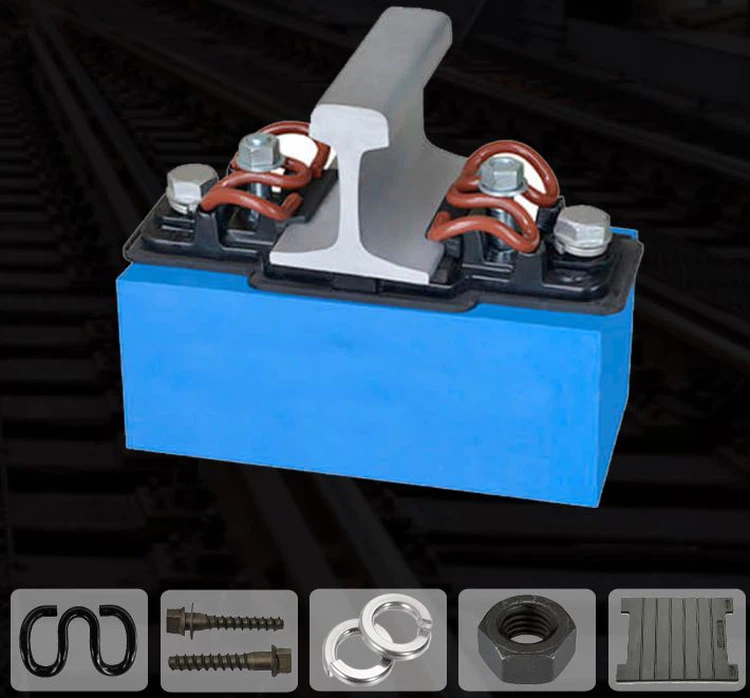
In order to improve the corrosion resistance and service life of components, some components need to be surface treated. Metal parts such as spring clips and spiral spikes are often galvanized and coated with anti-rust paint to form a protective layer on the surface to isolate water vapor and corrosive substances. After completing the surface treatment, the WJ-8 system is packaged according to different specifications and application scenarios. Generally, moisture-proof and collision-proof packaging materials such as wooden boxes and plastic films are used to classify and pack the components, and attach product certificates, test reports and other documents to ensure that the products are delivered in good condition.