


Fatigue Characteristics of Fasteners in Sections with Dense Small Curves in Urban Rail Transit
Q1: Why is fastener fatigue more prominent in small curves of urban rail transit?
A1: Small curve radius and large lateral force; frequent acceleration and deceleration, strong longitudinal impact; high train density and many cyclic load times. The superposition of multiple factors greatly accelerates the fastener fatigue speed.
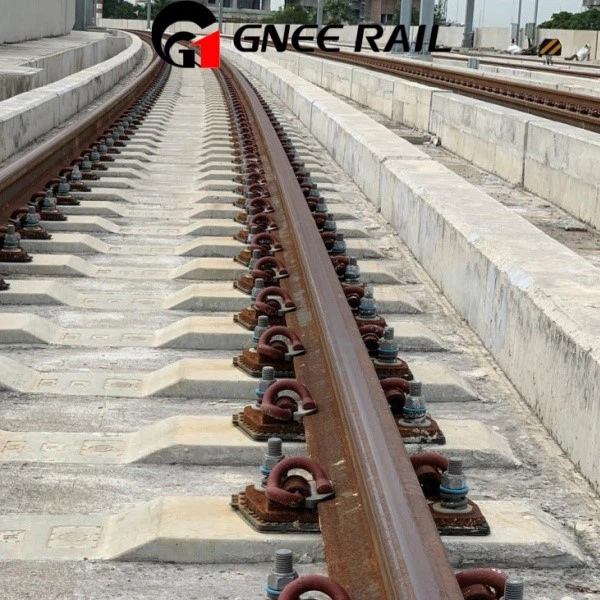
Q2: What is the main form of urban rail clip failure?
A2: Mainly fatigue cracks, permanent deformation and clamping force attenuation. The failure modes of inner and outer curve clips are different, with more eccentric fracture on the outer side and more obvious wear and loosening on the inner side.

Q3: What additional damage does frequent start-stop braking cause to fasteners?
A3: Repeated longitudinal impact leads to bolt loosening, clip slip, pad crushing, decreased gauge stability, and more frequent retightening and replacement.

Q4: Why is the wear speed of urban rail gauge blocks significantly faster?
A4: Small curves have large lateral sliding, strong wheel-rail impact, coupled with much dust, severe abrasive wear, rapid thinning of the gauge block working surface, and decreased support accuracy.
Q5: What aspects should be focused on in urban rail fastener selection and maintenance?
A5: Select fasteners with high fatigue, high wear resistance and high lateral resistance; shorten the inspection cycle; increase the retightening frequency; adopt reinforced component combinations in curve sections.