


What are the dimensions of the QU120 rail?
The QU120 crane rail is a heavy-duty steel rail profile manufactured in accordance with the Chinese metallurgical standard YB/T 5055-2014 (superseding YB/T 5055-1993 and GB/T 3426-1982). Engineered specifically for high-capacity lifting machinery, the QU120 profile features a wide head for wheel contact, an extra-thick web to resist lateral buckling, and a low center of gravity.
QU120 Rail Dimensional Parameters
- Rail Height: 170.0 mm
- Base Width: 170.0 mm
- Head Width (Running Surface): 120.0 mm
- Web Thickness: 44.0 mm
- Linear Mass (Theoretical Weight): 118.10 kg/m
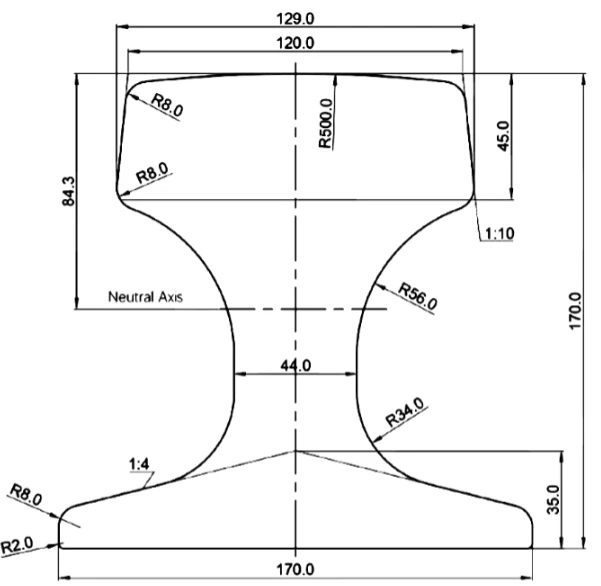
| Parameter | Symbol | Nominal Dimension (mm) | Standard Tolerance (YB/T 5055-2014) |
| Total Rail Height | H | 170.0 mm | ±1.0 mm |
| Head Width (Running Surface) | b | 120.0 mm | ±1.0 mm |
| Head Width at Transition Jaw | b₁ | 129.0 mm | ±1.2 mm |
| Base (Foot) Width | B | 170.0 mm | ±1.5 mm |
| Web Thickness | d | 44.0 mm | ±1.5 mm |
| Head Depth / Height | h₁ | 49.0 mm | Reference |
| Base Edge / Flange Thickness | t | 18.0 mm | ±1.0 mm |
| Neutral Axis Position | y (base to NA) | 82.4 mm | Calculated |
| Linear Theoretical Weight | W | 118.10 kg/m | ±3.0% (Rolling mass variation) |
GNEE RAILWAY RAILWAY supplies prime-rolled QU120 crane rails with integrated fabrication, inspection, and certification services. Rails are available in standard 12.0 m lengths or customized mill-run lengths from 6.0 to 18.0 m. Processing includes precision cutting, beveling, hole drilling, and horizontal or vertical pre-bending according to project drawings. Quality control covers 100% ultrasonic testing (UT), surface MPI inspection, straightness verification to ≤ 1.0 mm/m, and EN 10204 3.1 Mill Test Certificates (MTC), with third-party inspection by SGS, Bureau Veritas, TÜV, or other nominated agencies available upon request.
Sectional Properties & Engineering Mechanics
Structural and runway engineers require precise section moduli and moments of inertia to calculate girder load distribution, rail stress under local wheel contact, and rail bending fatigue. The table below outlines the structural section properties of the QU120 crane rail profile:

| Section Property | Metric Unit | Value | Imperial Equivalent |
| Cross-Sectional Area (A) | cm² | 150.45 cm² | 23.32 in² |
| Moment of Inertia (X-X axis, vertical) - I<sub>x</sub> | cm⁴ | 4,710.0 cm⁴ | 113.16 in⁴ |
| Section Modulus (Rail Head) - W<sub>x-head</sub> | cm³ | 537.6 cm³ | 32.81 in³ |
| Section Modulus (Rail Base) - W<sub>x-base</sub> | cm³ | 571.6 cm³ | 34.88 in³ |
| Moment of Inertia (Y-Y axis, horizontal) - I<sub>y</sub> | cm⁴ | 2,118.0 cm⁴ | 50.88 in⁴ |
| Section Modulus (Horizontal) - W<sub>y</sub> | cm³ | 249.2 cm³ | 15.21 in³ |
International Crane Rail Profile Comparison
International industrial projects frequently cross-specify crane rails between Chinese YB/T, German DIN 536, Chile GOST, and Indian ISCR standards. Although designated by nominal head widths, their cross-sectional heights, base geometries, and linear weights differ significantly:

| Profile | Governing Standard | Head Width (mm) | Rail Height (mm) | Base Width (mm) | Web Thickness (mm) | Weight ( kg/m ) |
| QU120 | YB/T 5055-2014 | 120.0 | 170.0 | 170.0 | 44.0 | 118.10 |
| DIN A120 | DIN 536-1 | 120.0 | 105.0 | 220.0 | 32.0 | 100.00 |
| KP120 | GOST 4121-96 | 120.0 | 170.0 | 170.0 | 44.0 | 113.47 |
| ISCR120 | IS 3443 | 120.0 | 170.0 | 170.0 | 44.0 | 118.00 |
Request Crane Rail Quote →
GNEE RAILWAY RAILWAY supplies a wide range of crane rails in different profiles and international standards, including QU series, DIN profiles, GOST profiles, and other crane rail specifications for industrial, port, mining, and infrastructure projects.
Frequently Asked Questions
Q1: What are the exact dimensions of the QU120 crane rail?
A: The QU120 crane rail has a total height of 170.0 mm, a bottom base width of 170.0 mm, a top head running width of 120.0 mm, and a central web thickness of 44.0 mm. Its nominal unit weight is 118.10 kg per meter.
Q2: Can a DIN 536 A120 rail be directly replaced with a QU120 crane rail?
A: No. While both rails have a 120 mm head width, their cross sections differ. The DIN A120 has a height of 105 mm and a base width of 220 mm, while the QU120 has a height of 170 mm and a base width of 170 mm. Direct replacement disrupts runway elevation, clip bolt centers, and rubber pad seatings.
Q3: What crane wheel tread width is recommended for the QU120 rail?
A: The running surface of the QU120 head is 120 mm. The recommended crane wheel tread width is typically 130 mm to 140 mm (10–20 mm wider than the rail head) to allow for crane skewing, track alignment drift, and flange clearance.
Q4: What steel grade is used to produce QU120 crane rails?
A: The primary standard grade is U71Mn high-carbon steel with a minimum tensile strength of 880 MPa. For higher wear resistance, U75V (minimum tensile strength 980 MPa) or head-hardened variants (340–380 HBW) are supplied.
Q5: What is the maximum wheel load capacity of the QU120 rail?
A: Depending on wheel diameter (typically 600 mm to 1,000 mm), crane travel speed, and material grade, the QU120 supports design wheel loads ranging between 350 kN and 800 kN (approximately 35 to 80 metric tons per wheel).
Q6: Which rail clips are compatible with the QU120 crane rail base?
A: Fastening systems require clips engineered for a 170 mm rail flange width and an 18 mm flange toe thickness, such as heavy-duty weldable flexible clips (e.g., Gantrex 9120 / 9220 or WJK QU120 clips) combined with matched elastomeric pads.