


As the core component of railway tracks, rails guide train wheels, bear enormous pressure, and transfer loads to sleepers. In electrified or automatic block sections, they also function as track circuits. Rail types vary widely based on different characteristics.
Classification by Weight per Meter
Rails are divided into crane rails, heavy rails, and light rails by their approximate weight (in kg) per meter:
Crane Rails (e.g., QU120, QU100): Made of manganese steel for crane tracks. QU120 weighs up to 118kg/m.
Heavy Rails: Commonly used in mainline railways, including specifications like 38kg/m, 43kg/m, 50kg/m, 60kg/m, and 75kg/m. New additions include 60kg/m heavy rails and 75kg/m heavy crane rails.
Light Rails: Weighing ≤30kg/m (e.g., 9kg/m, 12kg/m, 15kg/m), suitable for light transport in factories, mines, and forest railways.
| Classification | Height(mm) | Head (mm) | Bottom (mm) | Thick(mm) | Weight (kg/m) | |
| Light Rail | 8 KG/M | 65 | 25 | 54 | 7 | 8.42 |
| 9 KG/M | 63.5 | 32.1 | 63.5 | 5.9 | 8.94 | |
| 12 KG/M | 69.85 | 38.1 | 69.85 | 7.54 | 12.2 | |
| 15 KG/M | 79.37 | 42.86 | 79.37 | 8.33 | 15.2 | |
| 18 KG/M | 80 | 40 | 80 | 10 | 18.06 | |
| 22 KG/M | 93.66 | 50.8 | 93.66 | 10.72 | 22.3 | |
| 24 KG/M | 107 | 51 | 90 | 10.9 | 24.46 | |
| 30 KG/M | 107.95 | 60.33 | 107.95 | 12.3 | 30.1 | |
| Heavy Rail | 38 KG/M | 134 | 68 | 114 | 13 | 38.733 |
| 43 KG/M | 140 | 70 | 114 | 14.5 | 44.653 | |
| 45 KG/M | 145 | 67 | 126 | 14.5 | 45.546 | |
| 50 KG/M | 152 | 70 | 132 | 15.5 | 51.514 | |
| 60 KG/M | 176 | 73 | 150 | 16.5 | 60.64 | |
| Crance Rail | QU 70 | 120 | 70 | 120 | 28 | 52.8 |
| QU 80 | 130 | 80 | 130 | 32 | 63.69 | |
| QU 100 | 150 | 100 | 150 | 38 | 88.96 | |
| QU 120 | 170 | 120 | 170 | 44 | 118.1 | |
Classification by Steel Grade
Carbon Steel Rails: High-manganese, medium-carbon rails.
Microalloyed Rails: Added with elements like vanadium and titanium for superior strength and toughness.
Low-Alloy Rails: Contain low-level alloying elements.
By mechanical properties, they include ordinary rails (tensile strength ~780MPa), wear-resistant rails, and high-strength rails (≥1080MPa).
Classification by Delivery Condition
Hot-Rolled Rails: Delivered in as-rolled condition.
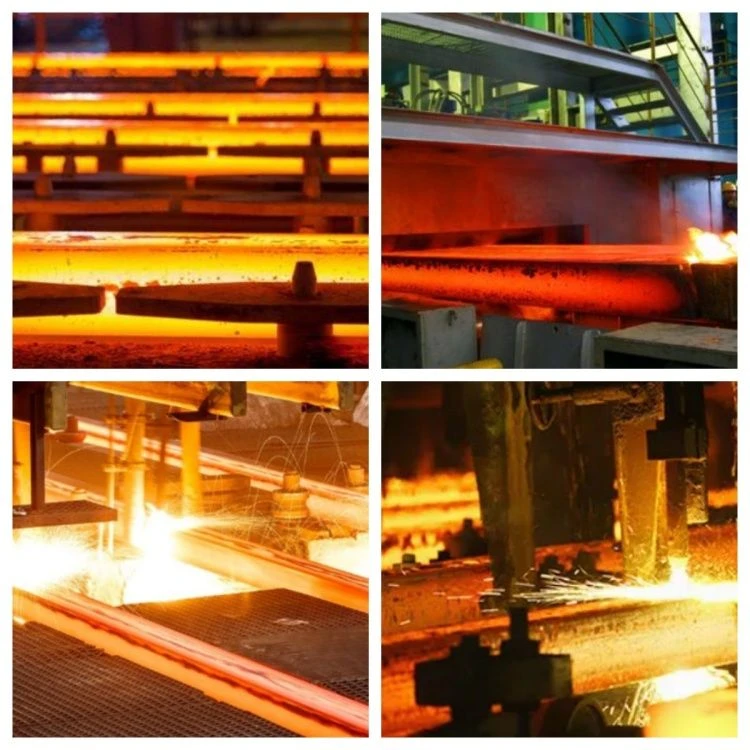
Heat-Treated Rails: Including off-line and on-line heat treatment, further divided into carbon, microalloyed, and low-alloy heat-treated rails based on chemical composition.
Practical Applications
Mainline Railways: Predominantly use 60kg/m rails.
Heavy-Haul Railways (e.g., Datong-Qinhuangdao Railway): Employ 75kg/m rails.
High-Speed Railways: Require 60kg/m rails manufactured with specific steel grades and processes to meet strict flatness and dimensional accuracy standards.
Railway Switches: Use asymmetric rails due to special stress and processing requirements.


Understanding rail types helps construction and maintenance personnel select optimal rails for different lines, ensuring efficient and safe railway operations.
As a professional supplier in the field of international steel trade, GNEE RAILWAY RAILWAY has long been committed to the global sales and service of GB standard heavy rails. Relying on China's strong steel industry foundation, we can provide customers with a full range of railway heavy rail products, from ordinary line rails to high-strength wear-resistant rails, with complete product specifications to meet the needs of different levels of railway construction.