


The rail fastening system is an essential part of the railway track structure, composed of various rail fasteners (OTM materials). Its main function is to firmly secure the rail onto the sleeper or track slab to ensure track stability. Fastening systems can be classified into different types according to track design, application scenarios, and material, and they are equipped with different components. The most common railway fastening systems include the Elastic clip IV Fastening System, Elastic clip V Fastening System, WJ-7 Fixing System, and WJ-8 Fastening System.
Tension Rail clip IV Fastening System
Components of the Elastic Bar IV Fastening System
The Elastic Clip IV Fastening System consists of elastic bars, insulating gauge blocks, rubber rail pads, and embedded iron shoulders.

| Number of parts for each set of rail clip IV fastening system | |||||
| Item No. | Name | Qty/set(pcs) | Material | Mass or Volume | Remark |
| 1 | G4 spring clip | 2 | 60Si2MnA | 1.60kg | Used in general areas |
| JA spring clip | 1.26kg | Used at rail joints | |||
| JB spring clip | 1.28kg | ||||
| 2 | Rail shoulder TZ4 | 2 | QT450-10 | 2.80Kg | |
| 3 | Rail insulator G4 | 2 | PA66 | 107.3cm3 | Used in general areas |
| Rail insulator G4J | 2 | 91.4cm3 | Used at rail joints | ||
| 4 | Rubber pad RP4 | 1 | Natural or synthetic rubber | 250cm3 | |
Installation Procedure
The installation of the Elastic Bar IV fastening system must strictly follow standard procedures, as every step directly affects track quality and train operation safety.
Placing the rubber rail pad: The rubber pad should be placed smoothly and precisely on the bearing groove of the track slab or sleeper. During installation, the centerline of the rubber pad must align exactly with the centerline of the groove. The pad and the groove must fit tightly, without any gaps, warping, or displacement.

Placing the rail: Clean the dirt from the upper and lower surfaces of the steel rail base, then position the rail steadily in the center of the rubber pad.

Installing insulating gauge blocks: Gauge block No. 9 should be placed on the outer side of the rail, and gauge block No. 11 on the inner side. The ears of the gauge blocks must lock onto the embedded iron shoulders. If manufacturing tolerances of rails, sleepers, or gauge blocks result in improper gauge or prevent the blocks from fitting in place, adjustments or replacements should be made accordingly.

Positioning the spring clip: The middle limb of the elastic clip must be correctly inserted into the hole, flat and upright, without tilting. It must not be pressed too tightly or leave excessive clearance.
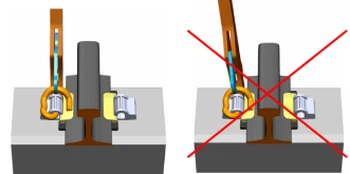
Special attention should be paid during installation: avoid forcing or pulling the elastic bar, apply proper force, and ensure that the fulcrum and point of application are correct.
GNEE RAIL supplies various railway fastening systems, including Type VI/Type VIII/WJ-12 systems for heavy-haul railways and Type I/II/III railway fixing systems for mixed passenger-freight lines. We also offer individual railway fasteners such as elastic clips, rail tie plates, rail pads, screw spikes, dog spikes, rail anchors, railway switch components, fish plates, bolts and nuts, and more. Contact GNEE for further product information.