


A rail fish plate is a structural connector that compensates for the loss of stiffness at rail discontinuities by clamping rail webs together, forming a temporary beam effect across the joint to reduce deflection and rail-end batter. It is indispensable in conventional jointed track structures.

GNEE RAIL offers fish plates compatible with GB rails, UIC profiles, DIN536 and QU crane rails, JIS rails, AS1085 sections, BS11 standards, and AREMA/ASCE rails, along with packaging solutions for overseas rail projects.
Types of Rail Joint Bar
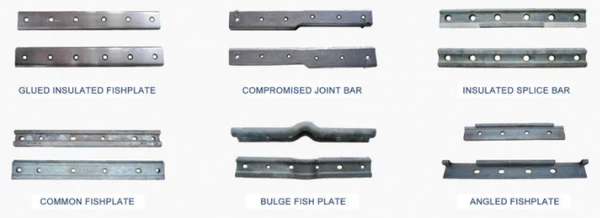
Rail joint bars, or fishplates, connect rail ends to ensure track continuity, categorized primarily by function into common (standard), compromise (different rail sizes), insulated (electrical isolation), and bridge joints. They are typically bolted (4 or 6 holes) for high strength, while welded options are also used.
Common Types of Rail Joint Bars
- Common Joint Bar (Fishplate): Standard, symmetrical bar with 4 or 6 holes, used to connect rails of the same size/profile.
- Compromise Joint Bar: Specifically designed with an irregular shape to connect two different rail sections (e.g., 50kg to 60kg).
- Insulated Joint Bar: Made of composite materials to prevent electrical current from passing between rail sections, crucial for signaling systems.
- Glued Insulated Joint (GIJ): A type of insulated joint where the bar is glued to the rail, providing higher strength and better sealing than traditional insulation.
- Bridge Joint: A specialized joint designed to provide increased support at the joint, often used when sleepers cannot be placed directly under the connection.
- Expansion Joint: Used in locations requiring significant movement to allow for thermal expansion/contraction.
| Joint Type | Key Specification / Description |
|---|---|
| Standard Rail Joint (Fish Plate) | - Profile: Matches the rail section (e.g., UIC 60, 136RE). - Length: Typically 600mm or 800mm per side. - Holes: 4 or 6 bolt holes per bar. |
| Insulated Rail Joint (IRJ) | - Material: Steel core with composite insulating end-posts/plates, or full epoxy composite. - Electrical Resistance: >10⁸ Ω. |
| Compromise Rail Joint | - Design: Connects two different rail profiles (e.g., UIC 54 to UIC 60). - Profile: Each side is machined to match its respective rail section. |
| Joggled Rail Joint | - Feature: Has a depressed (joggled) section to allow continuous rail head surface for smoother wheel passage. |
| Bridge Rail Joint | - Design: Often reinforced (thicker web/longer length) for high-stress locations like bridge approaches. |
| Glued Insulated Joint | - Construction: Steel bars bonded to composite insulation using high-strength adhesive for improved durability. |
| Welded Rail Joint (for CWR) | - Type: Flash-butt or thermite weld. - Specification: Weld must meet mechanical properties equal to or greater than the parent rail. |
| Expansion Joint (for BRE) | - Feature: Allows controlled thermal expansion in long rails on bridges or in extreme temperature zones. |
When to use insulated rail joiners?
Insulated rail joints (IRJs) are used to electrically isolate adjacent rail sections, creating independent track circuits essential for signaling, train detection, and safety systems. They prevent unwanted current flow in electrified, signaled lines, turnouts, and continuously welded rail (CWR) to identify train location.
Key Applications of Insulated Rail Joints:
- Signaling Systems: Used to create "block joints" at the boundary of track circuits, which allows the signalling system to detect if a train is occupying a specific segment of track.
- Turnouts and Switches: Installed at turnouts and switch sections to separate signaling circuits.

- Continuously Welded Rail (CWR): Bonded/glued insulated joints are necessary on high-tonnage, high-speed lines to maintain structural integrity while providing insulation.
- Yard and Secondary Tracks: Used on lower-speed, lower-tonnage tracks, where bolted, non-glued joints might be acceptable, although glued joints offer higher durability.
- Electrified Territory: Used to break up signal rails to prevent stray current from affecting signaling equipment.
What is the difference between insulated rail joints and regular rail joints?
Insulated rail joints (IRJs) differ from regular (common) rail joints primarily by providing electrical insulation between rail sections, whereas regular joints are made of steel and conduct electricity. IRJs use composite materials to separate track circuits for signaling, while regular joints connect rails securely.
Key Differences and Usage Examples:

- Function: Insulated joints break the electric current between track sections to monitor train presence (signaling), while regular joints only provide mechanical connection.
- Material: Insulated joints are made from high-strength composites, polyurethane, or insulating coatings. Regular joints are constructed from steel.
- Application: IRJs are crucial at block sections for signaling and in railway tracks to prevent electrical, thunderbolt, or corrosion issues. Regular joints are typically used in non-signaled tracks or before welding rails together.
Founded in 2008, GNEE RAIL is a leading global manufacturer and supplier of railway components, specializing in high-quality rail fish plates (joint bars/splice bars) with strong production capacity and global service capabilities.
Our rail fish plate portfolio is comprehensive and compliant with international standards including UIC, AREMA, BS, DIN, and GB, covering light rail (8kg-30kg), heavy rail (38kg-75kg), and crane rail (QU70-QU120) systems. We offer diverse types such as insulated joint bars, bulged fish plates, and compromise rail joints,with precise specifications (4-hole/6-hole, 24-inch/36-inch), ensuring excellent mechanical performance.We uphold strict quality control supported by ISO 9001:2015 certification, an in-house inspection center, and third-party audits by SGS and BV. Our one-stop service includes customization, production, packaging, and after-sales support, tailored to clients' project needs.