


What is the theoretical weight of GB standard QU120 crane rail?
The theoretical weight of GB standard QU120 crane rail is 118.1 kg per meter, making it the highest-load profile in the Chinese QU series crane rail range. This weight is calculated from its standard cross-sectional area of 150.44 cm², and it is the most widely cited value across industry reference sources for QU120 rail produced under the YB/T 5055 standard.
QU120 Crane Rail Core Specifications
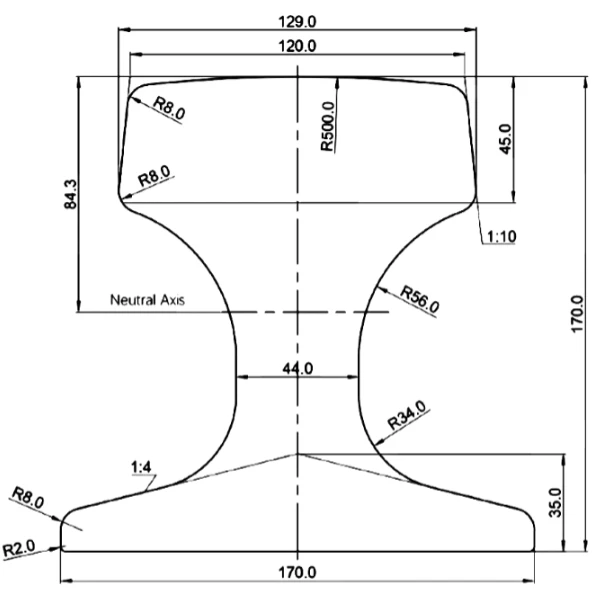
The table below lists the key dimensional and weight parameters of standard QU120 crane rail:
| Parameter | Value | Unit | Note |
|---|---|---|---|
| Theoretical weight per meter | 118.1 | kg/m | Main industry reference value |
| Cross-sectional area | 150.44 | cm | Basis for weight calculation |
| Rail height | 170 | mm | - |
| Rail head top flat width | 120 | mm | Maximum head width including 1:10 side slopes is 129 mm |
| Rail base width | 170 | mm | - |
| Web thickness | 44 | mm | - |
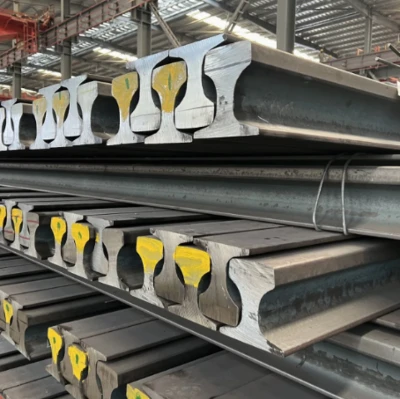
| Standard stock length | 12 | m | Custom lengths from 6 m to 12.5 m available |
Standard & Material Context
QU120 crane rail falls under the Chinese YB/T 5055 standard for crane rails, with the 2014 edition being the most widely implemented version in current production. The default material grade is U71Mn, a medium-manganese rail steel with a minimum tensile strength of 880 MPa and a delivery hardness of 260 HBW, balanced for wear resistance and toughness under repeated heavy wheel loads. For higher-stress applications, U75V grade with a minimum tensile strength of 980 MPa is also available as an option.
| Steel Grade | C(%) | Si | Mn | Cr | V | P | S | Tensile Strength (Rm/MPa) |
| U71Mn | 0.65~0.76 | 0.15~0.58 | 0.70~1.40 | – | – | ≤0.035 | ≤0.030 | ≥880 |
| U75V | 0.71~0.80 | 0.50~0.80 | 0.75~1.05 | – | 0.04~0.12 | ≤0.035 | ≤0.030 | ≥980 |
Compared to standard heavy railway rails, QU120 has a wider head, lower overall height and thicker web. This profile distributes concentrated wheel loads more evenly, reduces rail wear, lowers the center of gravity of the crane travel system, and resists deformation under heavy vertical and horizontal forces - making it suitable for extreme-duty lifting operations.
Typical Application Scenarios
QU120 rail is specified for heavy industrial and port lifting systems where wheel loads and operating cycles exceed the limits of smaller QU series profiles. Common uses include ship-to-shore cranes and rail-mounted gantry cranes at large container ports, heavy gantry cranes in shipyards and steel mills, stacker-reclaimers in bulk material yards, and heavy-duty automated storage and logistics systems. It is also used for trolley rails on large cranes, where short custom-cut lengths are often required to fit limited beam space while supporting high-speed, high-load trolley movement.
For projects requiring custom hole patterns, curved rail sections, end machining or corrosion protection for coastal environments, GNEE RAILWAY RAILWAY provides cutting, drilling, machining and surface treatment based on customer drawings, with both standard and customized specifications across GB and other international rail standards.
Contact GNEE RAILWAY RAILWAY · Ask for a QU120 Crane Rail Custom Processing Plan
Procurement & Quality Considerations
When sourcing QU120 crane rail, buyers should first confirm that the material grade and dimensional tolerances match their project design requirements. Standard QU series tolerance ranges include ±1 mm for head width, ±0.8 mm for rail height and ±1 mm for web thickness. For heavy-load joints, 10.9 grade high-strength bolts are recommended to maintain connection stability under repeated impact loads.
Quality control at GNEE RAILWAY RAILWAY covers material verification, mechanical testing, dimensional inspection and non-destructive testing. EN 10204 3.1 mill test certificates and third-party inspection reports are available upon request, with each rail end stamped with heat and batch numbers for full traceability back to the melting and rolling process.

Frequently Asked Questions
Is QU120 interchangeable with ISCR120 or KP120 rail from other standards?
QU120 is often cross-referenced as ISCR120 in the Indian market and KP120 in the Chile market due to similar nominal sizes. However, full interchangeability should be verified by comparing dimensional tolerances, material properties and standard requirements before installation, as different regional standards may have minor specification differences.
What length options are available for QU120 crane rail?
The standard stock length for QU120 rail is 12 meters. Custom length options include 9 m, 9.5 m, 10 m, 10.5 m, 11 m, 11.5 m and 12.5 m, with shorter lengths from 6 m to 8.9 m also available for special project needs such as trolley rail sections.
What supporting components are used with QU120 crane rail?
Common matching components for QU120 include joint bars, rail clips, high-strength bolts, rubber pads and pressure plates. For heavy-duty crane applications, aluminothermic welding kits are also used to create seamless joints, which reduce wheel impact at rail connections and extend both rail and crane wheel service life.
How is QU120 crane rail packed for export?
QU120 rails are bundled with heavy steel straps and coated with anti-rust treatment before shipment. For ocean transport, they are loaded into standard containers, flat racks or break-bulk vessels depending on the rail length and order volume, with wooden supports inside containers to prevent shifting during transit. Small matching fasteners are packed separately in moisture-resistant plywood cases.
GNEE RAILWAY RAILWAY supplies QU120 crane rail along with matched fastening systems and custom machining services for port, steel mill, shipyard and heavy industrial projects worldwide. Full drawing support and mill test certificates are provided with every order to ensure material traceability and compliance with project specifications.📞 Contact GNEE RAILWAY RAILWAY · Request QU120 Crane Rail Drawing-Based Customization & MTC