


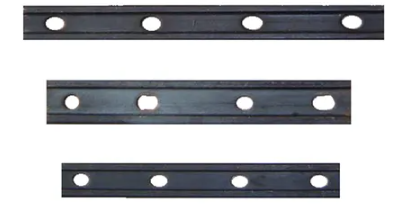
A rail fish plate is a precision-formed steel connector that stabilizes rail ends by re-establishing alignment and load-sharing capacity at joints, ensuring that track performance remains reliable in non-welded rail systems. GNEE RAILWAY RAILWAY produces fish plates for GB light rail and heavy rail, UIC profiles, DIN536 and QU crane rails, JIS rails, AS1085 rails, BS11 sections, and AREMA/ASCE rail systems, and coordinates joint supply with rail shipment schedules.
| Standard | Type | Length/Diameter | Weight /Material | |
| AREMA 2007 | 115RE | 4 hole-24" | 17.04Kg | 45# chemical |
| 115RE | 6 hole-36" | 25.56Kg | composition(%): | |
| 132-136RE | 4 hole-24" | 17.75Kg | C: 0.42-0.50 | |
| 132-136RE | 6 hole-36" | 26.63Kg | Mn: 0.50-0.80 | |
| UIC864 | UIC60 | 4 hole-630/Φ26 | 18.07Kg | Si: 0.17-0.37 |
| UIC60 | 4 hole-600/Φ28 | 17.47Kg | Cr: ≤0.25 | |
| UIC60 | 4 hole-630/Φ25 | 18.1Kg | P: ≤0.035 | |
| UIC54 | 4 hole | 14.34Kg | S: ≤0.035 | |
| UIC54 | 6 hole-800 | 19.94Kg | ||
| BS 47-1 | BS75R | 4 hole | 6.56Kg | |
| BS60A | 4 hole | 5.61Kg | ||
| BS80A | 4 hole | 6.5Kg | ||
| BS90A | 685.8/Φ26 | 13.23Kg | 50# chemical | |
| BS90A | 792.9/Φ26.2 | 15.34Kg | composition(%): | |
| BS100A | 4 hole | C: 0.62-0.70 | ||
| 90/91LB | 4 hole | 18.08Kg | Mn: 0.50-0.80 | |
| 90/91LB | 6 hole | 19.9Kg | Si: 0.17-0.37 | |
| AS | 50kg | 4 hole | 14.3Kg | Cr: ≤0.25 |
| 50kg | 6 hole | 19.5Kg | P: ≤0.035 | |
| S49 | 4 hole | 9.71Kg | S: ≤0.035 | |
What is the function of rail joints bar?
A rail joint bar (or fishplate) is a metal component that connects two railway rail ends, creating a continuous, stable path for trains while maintaining proper alignment and structural integrity. They prevent vertical and lateral movement, distribute wheel loads, and allow for thermal expansion/contraction.

- Connecting Rail Ends: They securely bridge the gap between two rails to form a continuous track.
- Maintaining Alignment: They ensure the rails remain properly aligned, preventing horizontal or vertical misalignment.
- Load Distribution: By joining the rails, they distribute the weight of the train across the joint, minimizing stress and damage.
- Expansion and Contraction: They provide necessary room for expansion or contraction of the rails due to temperature changes.
- Safety and Stability: They prevent rail separation, significantly reducing the risk of derailments or accidents.
What Are the Main Causes of Fish Plate Failures?
Fish plate failures, which compromise railway track integrity, are primarily caused by excessive dynamic loading, material fatigue, and improper maintenance. Key factors include bolt slackening, corrosion, improper installation, and cold weather, leading to cracks, fractures, and deformation.

- Excessive Mechanical Loading: High-frequency, heavy-haul traffic causes severe stress on the rail joints, leading to plastic deformation and fatigue fractures, especially when the rail gap is too large.
- Bolt Slackening and Improper Maintenance: Vibrations from passing trains loosen bolts, causing a loss of clamping force. This increases the load on the fish plate itself, leading to faster wear and potential breakage.
- Material Defects and Brittle Fracture: Poor quality steel or inadequate heat treatment can result in insufficient toughness, making the plates prone to cracking, particularly in cold, winter conditions.
- Corrosion and Environmental Factors: Rust caused by moisture and harsh environmental conditions reduces the effective thickness of the fish plate, weakening its structural integrity.
- Improper Installation or Incompatibility: Using the wrong size fish plate for the rail profile, or failure to properly tighten bolts during installation, can create uneven stress distribution.
How to prevent rail joint failure?
Preventing rail joint failure requires a combination of regular, meticulous inspection and proper maintenance, focusing on bolt tension, lubrication, and structural integrity. Key measures include maintaining at least two sound, tight bolts per rail end, using anti-creep devices, ensuring proper rail gaps for thermal expansion, and implementing effective ballast maintenance to reduce stress.

Founded in 2008, GNEE RAILWAY RAILWAY is a leading global manufacturer and supplier of railway components, specializing in high-quality rail fish plates (joint bars/splice bars) with strong production capacity and global service capabilities.
Our rail fish plate portfolio is comprehensive and compliant with international standards including UIC, AREMA, BS, DIN, and GB, covering light rail (8kg-30kg), heavy rail (38kg-75kg), and crane rail (QU70-QU120) systems. We offer diverse types such as insulated joint bars, bulged fish plates, and compromise rail joints,with precise specifications (4-hole/6-hole, 24-inch/36-inch), ensuring excellent mechanical performance.We uphold strict quality control supported by ISO 9001:2015 certification, an in-house inspection center, and third-party audits by SGS and BV. Our one-stop service includes customization, production, packaging, and after-sales support, tailored to clients' project needs.