


Stress Flow Design and Crack Resistance Optimization of the Arc Transition Zone in Fishplates
Why do most fish plate fractures originate at the fillet transition zone of bolt holes?
During operation, the fish plate body bears tensile forces from the rail, while bolt holes endure shear and compressive forces from bolts. These forces converge at the bolt hole edges, creating extreme stress concentration. A sharp corner or small fillet radius causes stress lines to bend and crowd violently, generating massive stress peaks. Repeated train vibrations transform these peak stress zones into fatigue crack initiation sites. Once initiated, cracks propagate rapidly along stress lines, eventually causing fish plate fracture.
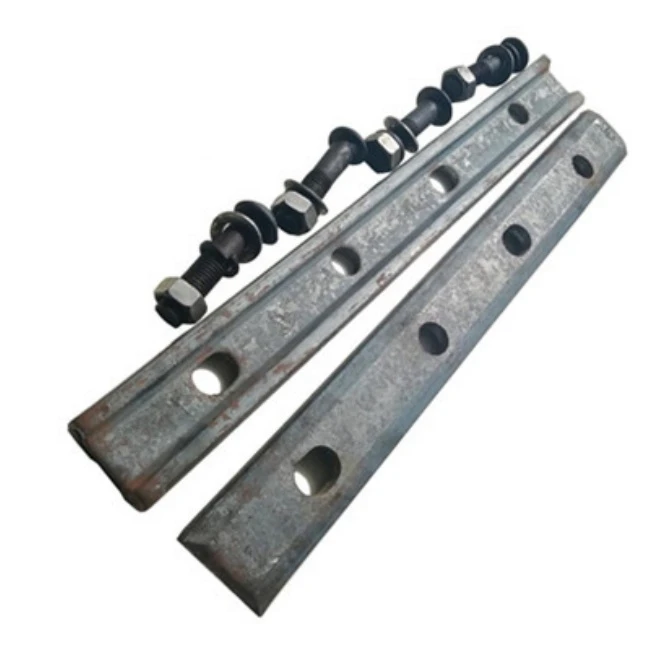
What is "stress flow design" and how does it improve the stress state of transition zones?
Stress flow design is a structural optimization method that simulates force transmission paths to refine geometric shapes. For fish plates, it requires bolt hole fillets to have sufficiently large radii and to be smoothly tangent to the plate contour. This design allows stress lines, once concentrated at hole edges, to spread smoothly across the plate body along the fillet. Stress flow no longer mutates, reducing peak stress by over 40%. By guiding uniform stress distribution, it fundamentally eliminates the mechanical conditions for crack initiation.

What are the design differences in fillet radii between Chinese and international standard fish plates?
Chinese standard fish plates, designed for conventional and general heavy-haul lines, specify fillet radii typically between 6mm and 10mm, meeting regular stress dispersion needs. International standards like UIC and AREMA, for high-speed and heavy-haul lines, mandate larger radii, usually 12mm to 15mm or more. Some international standards adopt "double-radius" or "parabolic" transitions, offering superior stress dispersion to single radii. This design difference directly reflects varying requirements for fish plate fatigue life across standards.

How does manufacturing technology affect the stress flow effect of fillets?
Perfect design is compromised by poor manufacturing. For example, drilling followed by simple chamfering leaves sharp tool marks, creating new stress concentration points. High-quality fish plates use punching or precision boring to ensure fillet smoothness. Additionally, oxide scale remaining after heat treatment forms micro-stress sources. Thus, fine grinding of transition zones is mandatory to meet surface roughness standards. Only when manufacturing precision matches design intent can stress flow optimization be truly achieved.
What emergency measures should be taken if micro-cracks are found in fish plate transition zones?
Micro-cracks in transition zones indicate stress concentration has exceeded the material fatigue limit, requiring immediate action. First, drill a stop-hole at the crack tip-slightly larger than the crack width-to prevent further propagation. Second, strengthen the joint by installing auxiliary fish plates to share the load. Simultaneously, reduce train speed and restrict axle loads in the section. Most importantly, send the batch for inspection to determine if failures stem from design flaws, manufacturing issues, or excessive line loads, addressing the root cause.