


Knowledge on the Relationship between Rail Spike Anchorage Quality and Track Stability
What are the proportioning requirements for rail spike anchoring materials?
The proportion (weight ratio) of sulfur anchoring materials is sulfur:cement:sand:paraffin=1:0.8:1.5:0.03 to ensure that the anchoring agent strength is ≥40MPa. Inorganic chemical anchoring agents need to be proportioned according to the instructions, usually the ratio of component A to component B is 3:1, mixed evenly before use to avoid agglomeration affecting the anchoring effect. When the proportion deviation exceeds ±5%, it will lead to a decrease in the strength of the anchoring agent, insufficient pull-out resistance, and the rail spike is prone to loosening. The heating temperature during sulfur anchoring should be controlled at 140-160℃; excessive temperature will cause sulfur combustion and reduce anchoring quality. The stirring time is not less than 3 minutes to ensure uniform mixing of each component and improve the adhesion and compressive strength of the anchoring agent.
What is the control standard and influence of rail spike anchoring depth?
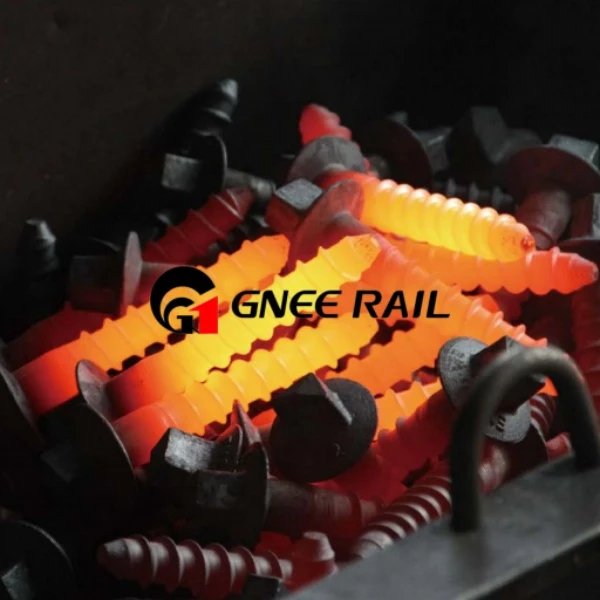
The standard anchoring depth of spiral rail spikes is 160mm, with an allowable deviation of ±5mm to ensure the connection strength between the rail spike and the sleeper. Insufficient anchoring depth will significantly reduce the pull-out resistance of the rail spike, which is prone to loosening during train vibration and affects track stability. Excessively deep anchoring depth will cause the top of the rail spike to be higher than the sleeper surface, affecting the installation accuracy of the pressing plate and indirectly leading to uneven rail surface. The anchoring depth needs to be controlled by a special mold, and the rail spike should be inserted vertically during installation to avoid depth deviation caused by inclination. The anchoring depth of different sleeper types is slightly different; the anchoring depth of concrete sleepers is usually 20-30mm deeper than that of wooden sleepers to adapt to different bearing requirements.

What is the standard for the pull-out resistance of rail spikes after anchoring?
The pull-out resistance of rail spikes for ordinary lines is ≥60KN to ensure no loosening under train vibration and temperature changes. The pull-out resistance of rail spikes for heavy-haul railways is ≥80KN, adapting to large load impacts and ensuring track stability. The pull-out resistance of rail spikes for urban rail transit is ≥70KN to meet the requirements of high-frequency vibration scenarios. Pull-out resistance testing should be carried out after the anchoring agent is completely cured (24 hours for sulfur anchoring, 48 hours for chemical anchoring), and sampling inspection should be performed using a pull-out resistance tester. The sampling pass rate must reach 100%; if unqualified products appear, all anchored rail spikes of this batch need to be re-inspected and handled.
What are the common quality defects of rail spike anchoring?
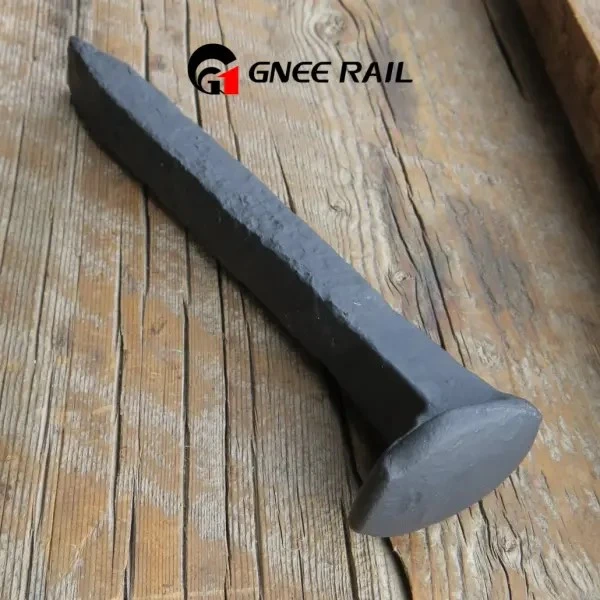
Anchoring agent voids are common defects, mostly caused by uneven stirring or insufficient pouring, which will reduce the pull-out resistance and stability of the rail spike. If the rail spike inclination deviation exceeds 1°, it will cause uneven force, and there is a risk of loosening or fracture after long-term use. The anchoring agent is not firmly bonded to the wall of the reserved hole of the sleeper, and there is a gap, which will lead to water infiltration, accelerating the corrosion of the rail spike and the aging of the anchoring agent. If the top of the rail spike is higher than the sleeper surface by more than 3mm, it will affect the installation of the pressing plate and lead to insecure rail fixing. Cracks in the anchoring agent after curing will reduce the strength, making it unable to withstand train load impacts, and the rail spike is prone to loosening.
How to improve the quality of rail spike anchoring?
Before anchoring, it is necessary to clean the dust, accumulated water and debris in the reserved holes of the sleeper to ensure the hole wall is dry and clean, and improve the adhesion of the anchoring agent. Use special pouring tools to ensure that the anchoring agent is fully poured without voids and bubbles. The rail spike should be kept vertical when inserted, calibrated with a level, and the deviation should be controlled within 1°. After sulfur anchoring, it should be covered and insulated, and slowly cooled to room temperature to avoid cracking of the anchoring agent caused by rapid cooling. Curing is required after anchoring is completed: 24 hours for sulfur anchoring and 48 hours for chemical anchoring. Disturbing the rail spike is prohibited during curing.