


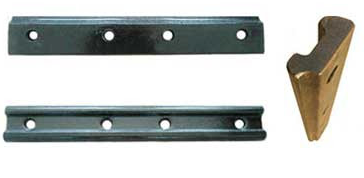
A rail fish plate is a bolted joint reinforcement device that stabilizes rail ends by providing lateral restraint and vertical stiffness, ensuring that wheel loads are transmitted across joints without causing excessive deflection or vibration. GNEE RAILWAY RAILWAY offers fish plates for GB, UIC, DIN536, QU, JIS, AS1085, BS11, and AREMA/ASCE rail standards, with services including joint component packaging and fastening compatibility checks.
How much does a railway fish plate weight?
Railway fish plates (or joint bars) typically weigh between 12 kg and 30 kg per piece, depending on the rail size, length, and number of bolt holes. Common heavy rail fish plates weigh around 18-26 kg for 4-hole or 6-hole types, while lighter rails may use plates weighing 12-15 kg.

Common Railway Fish Plate Weights
- 52 kg/60 kg Rail Fish Plates: Generally weigh between 18 kg and 30 kg per unit.
- 4-Hole Fish Plate (UIC54/UIC60): Approximately 15.6 kg to 18 kg.
- 6-Hole Fish Plate (UIC54/UIC60): Approximately 22.9 kg or more.
- Light Rail Fish Plates: 9 kg, 12 kg, 15 kg, 18 kg, 22 kg, 24 kg, or 30 kg depending on the specific rail designation.
- Joggled Fish Plates: Often around 12-15 kg.

| Standard | Type | Length/Diameter | Weight /Material | |
| AREMA 2007 | 115RE | 4 hole-24" | 17.04Kg | 45# chemical |
| 115RE | 6 hole-36" | 25.56Kg | composition(%): | |
| 132-136RE | 4 hole-24" | 17.75Kg | C: 0.42-0.50 | |
| 132-136RE | 6 hole-36" | 26.63Kg | Mn: 0.50-0.80 | |
| UIC864 | UIC60 | 4 hole-630/Φ26 | 18.07Kg | Si: 0.17-0.37 |
| UIC60 | 4 hole-600/Φ28 | 17.47Kg | Cr: ≤0.25 | |
| UIC60 | 4 hole-630/Φ25 | 18.1Kg | P: ≤0.035 | |
| UIC54 | 4 hole | 14.34Kg | S: ≤0.035 | |
| UIC54 | 6 hole-800 | 19.94Kg | ||
| BS 47-1 | BS75R | 4 hole | 6.56Kg | |
| BS60A | 4 hole | 5.61Kg | ||
| BS80A | 4 hole | 6.5Kg | ||
| BS90A | 685.8/Φ26 | 13.23Kg | 50# chemical | |
| BS90A | 792.9/Φ26.2 | 15.34Kg | composition(%): | |
| BS100A | 4 hole | C: 0.62-0.70 | ||
| 90/91LB | 4 hole | 18.08Kg | Mn: 0.50-0.80 | |
| 90/91LB | 6 hole | 19.9Kg | Si: 0.17-0.37 | |
| AS | 50kg | 4 hole | 14.3Kg | Cr: ≤0.25 |
| 50kg | 6 hole | 19.5Kg | P: ≤0.035 | |
| S49 | 4 hole | 9.71Kg | S: ≤0.035 | |
Factors Affecting Weight
- Length: Standard lengths range from 300 mm to over 1000 mm for heavy-duty, 6-hole, or 8-hole bars.
- Thickness: Standard thickness is typically between 20 mm and 30 mm.
- Material: Made from high-strength steel, with a density that contributes to the overall weight.
| Material Type | Typical Grade / Designation | Chemical Composition (wt%) | Notes / Equivalent Standards |
|---|---|---|---|
| Carbon Structural Steel | Q235 (GB/T 700) | C: ≤0.22 Si: ≤0.35 Mn: 0.30-0.65 P: ≤0.045 S: ≤0.045 |
Common mild steel for general joint bars. Similar to ASTM A36, S235JR. |
| Carbon Structural Steel | Q255 (GB/T 700) | C: 0.18-0.28 Si: ≤0.35 Mn: 0.40-0.70 P: ≤0.045 S: ≤0.045 |
Slightly higher strength than Q235. |
| Medium Carbon Steel | 50Mn / 50BA (GOST 10779) | C: 0.47-0.55 Si: 0.17-0.37 Mn: 0.80-1.20 P: ≤0.040 S: ≤0.045 |
Classic high-strength fish plate steel. Widely used for mainline joints. |
| Medium Carbon Steel | 55# (GB/T 699) | C: 0.52-0.60 Si: 0.17-0.37 Mn: 0.50-0.80 P: ≤0.035 S: ≤0.035 |
Standard medium carbon steel for demanding applications. Similar to AISI 1055. |
| Alloy Steel | 42CrMo (GB/T 3077) | C: 0.38-0.45 Si: 0.17-0.37 Mn: 0.50-0.80 Cr: 0.90-1.20 Mo: 0.15-0.25 P: ≤0.035 S: ≤0.035 |
High-strength, high-toughness alloy for severe service. Similar to AISI 4140/4142. |
| Spheroidal Graphite Cast Iron | QT450-10 (GB/T 1348) | C: 3.60-3.90 Si: 2.00-3.00 Mn: ≤0.50 P: ≤0.07 S: ≤0.015 Mg: 0.03-0.06 (Nodulizer) |
Used in some traditional/joint kits for its castability and damping properties. Similar to EN-GJS-450-10. |
How do fish plates work?
Fish plates (or joint bars) are metal plates bolted to both sides of connecting railway tracks, sitting tightly between the top railhead and bottom flange, to provide structural, load-bearing continuity. They ensure precise alignment of rails, manage thermal expansion/contraction, and transfer train loads to prevent joint deflection.

- Structural Support and Alignment: They connect two rail ends, maintaining both horizontal and vertical alignment to provide a smooth, continuous track.
- Load Distribution: As trains pass, fish plates distribute the intense wheel weight across the joint to prevent the rail ends from bending or breaking.
- Thermal Management: The holes in fish plates are often slotted, allowing the rails to expand or contract due to temperature changes without causing the track to warp or break.
- Safety and Security: They hold the track together, acting as a sturdy fastener that prevents rails from separating or shifting.
Founded in 2008, GNEE RAILWAY RAILWAY is a leading global manufacturer and supplier of railway components, specializing in high-quality rail fish plates (joint bars/splice bars) with strong production capacity and global service capabilities.
Our rail fish plate portfolio is comprehensive and compliant with international standards including UIC, AREMA, BS, DIN, and GB, covering light rail (8kg-30kg), heavy rail (38kg-75kg), and crane rail (QU70-QU120) systems. We offer diverse types such as insulated joint bars, bulged fish plates, and compromise rail joints,with precise specifications (4-hole/6-hole, 24-inch/36-inch), ensuring excellent mechanical performance.We uphold strict quality control supported by ISO 9001:2015 certification, an in-house inspection center, and third-party audits by SGS and BV. Our one-stop service includes customization, production, packaging, and after-sales support, tailored to clients' project needs.