


rail gauge tie bar
A gauge rod is a kind of track material used to keep track in gauge by improving the lateral stability of the rail. It is an essential reinforcement accessory for railroad tracks. Gauge rods are mostly applied at weak points in straight tracks, curved tracks, switches, bad ties, etc. Placing under the parallel rails, can grip the rails and prevent them from spreading or tilting. If the gauge rods are missing in weak sections of railway tracks, derailment accidents or even the overturn of trains may happen. Other track materials such as rail joints, rail clips, rail clamps, and rail pads are also available.

Types of gauge rods include insulated gauge rods and non-insulated gauge rods. Insulated gauge rods are needed in railway lines with the electric circuit. The insulation material is placed in the middle of the rod.
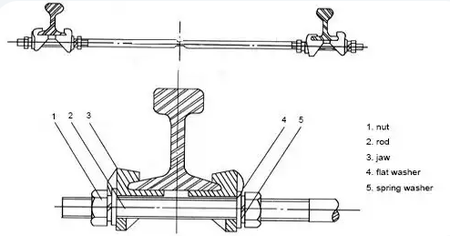
| No. | Part | Quantity | Specification | Material |
|---|---|---|---|---|
| 1 | nut | 4 | M30 M36 | 3# |
| 2 | rod | 1 | M30 M36 | 3# |
| 3 | iron jaws | 4 | I type II type | KTH350-10 |
| 4 | flat washer | 4 | M30 M36 | 3# |
| 5 | spring washer | 4 | M30 M36 | 65Mn |
How is a gauge tie rod installed?
A rail gauge tie rod is installed by placing its clamping devices on the feet of the two parallel rails and tightening a connecting rod to hold them at the correct distance apart. This process is often done in areas of the track that are prone to widening, such as sharp curves or switches, and requires using the correct type of rod (e.g., insulated for track-circuited routes). The tie rod connects the two rails, prevents them from spreading, and increases lateral stability.
Installation steps
- Assess the location: Determine if a standard or insulated tie rod is needed.
- Position the clamps: Place the clamping devices (malleable jaws) of the tie rod onto the feet of the two parallel rails.
- Set the gauge: Adjust the length of the tie rod to achieve the correct rail gauge for that section of the track. The rod's size is selected based on the gauge distance.

- Connect and tighten: Fasten the connecting rod by tightening the components, which may include nuts, spring washers, and flat washers, ensuring it is securely attached to the clamps.
- Install correctly: Ensure the tie rod is installed with the insulation on the same side if it's an insulated type.
- Stabilize the section: Place at least three tie rods in plain line sections to spread the load and prevent gauge faults from spreading.
Typical Railroad Gauge Rods
Our hot sale products are double-ended gauge rods for non-insulated or insulated types. They are a typical gauge rod with 2 iron jaws, 2 flat washers, 2 nuts, and 2 spring washers on both ends.
- Application: 43,50,60,75kg/m rail
- Rail gauge: 600, 762, 900 and 1450.
- Diameter: 20, 22, 24, 28, 32, 36 etc.
- Specification: 20×870, 22×880, 22×1050, 24×1050, 24×1250, 28×1810, 28×1850, 32×1810, 32×1850, 36×1850

GNEE RAILWAY RAILWAY supplies both insulated gauge rods and non-insulated gauge rods for 56-½" track and rails of 60-140 lbs, AREMA 1-1/4 ", and other gauge rods used in BS, UIC rails, with lengths of 600mm,762mm,900mm,1435mm, etc. Other types of gauge rods are available according to your special requirements.
Send your special customization requirements to GNEE RAILWAY.