


Fatigue Life Design and Adaptation Optimization of Track Vibration Loads for Elastic Clips
What are the core impacts of track vibration load amplitude and frequency on the fatigue life of track spring clips?
The amplitude and frequency of track vibration load are the two key factors affecting the fatigue life of track spring clips. Their combined effect directly determines the fatigue damage rate of the clip; the larger the amplitude and the higher the frequency, the shorter the fatigue life. A larger vibration load amplitude results in greater elastic deformation of the clip during operation, leading to higher alternating stress within the clip. When the alternating stress approaches the clip's fatigue limit, microcracks are prone to form, and the propagation of these microcracks significantly shortens the fatigue life. A higher vibration load frequency results in more deformation cycles per unit time, causing rapid accumulation of fatigue damage. Even if the alternating stress is below the fatigue limit, long-term high-frequency cycling can still lead to fatigue failure. The vibration load amplitude on heavy-load lines is 30%-40% higher than that on conventional lines, and the vibration frequency on high-speed lines is 50%-60% higher. Therefore, the fatigue life design requirements for heavy-load and high-speed track spring clips are much higher than those for conventional lines. The fatigue life design of spring clips needs to be precisely set according to the load amplitude and frequency of different lines to ensure that the fatigue damage rate matches the service life of the line.

How to precisely match the fatigue limit of the elastic strip material with the alternating stress of the track?
The precise matching of the fatigue limit of the elastic strip material with the alternating stress of the track is the core of the elastic strip fatigue life design, which is mainly realized through three steps: determining stress, selecting material and adjusting process, to ensure that the alternating stress is always lower than the fatigue limit. First, through mechanical simulation calculation, determine the actual alternating stress value of the elastic strip under the corresponding line working conditions, comprehensively consider the vibration load amplitude, frequency, elastic strip deformation and other factors, and obtain the maximum alternating stress under the most unfavorable working conditions. Second, select the adapted material according to the maximum alternating stress value. The common 60Si2MnA steel for elastic strips has a fatigue limit of about 450MPa, and 60Si2CrVA steel has a fatigue limit of about 550MPa. Heavy-haul and high-speed lines have high alternating stress, so 60Si2CrVA steel with high fatigue limit is selected; ordinary-speed lines have low alternating stress, and 60Si2MnA steel can meet the demand. Third, adjust the actual fatigue limit of the material through heat treatment process. For elastic strips of heavy-haul lines, the "quenching + medium temperature tempering" process is adopted to increase the fatigue limit of the material by another 10%-15%, so that the fatigue limit and alternating stress maintain a reasonable safety margin, which should be controlled above 20% to avoid the alternating stress exceeding the fatigue limit due to load fluctuation. At the same time, the material must be inspected batch by batch in production to ensure that the deviation between the actual fatigue limit and the design value is ≤±5%, realizing the precise matching of fatigue limit and alternating stress from the source.
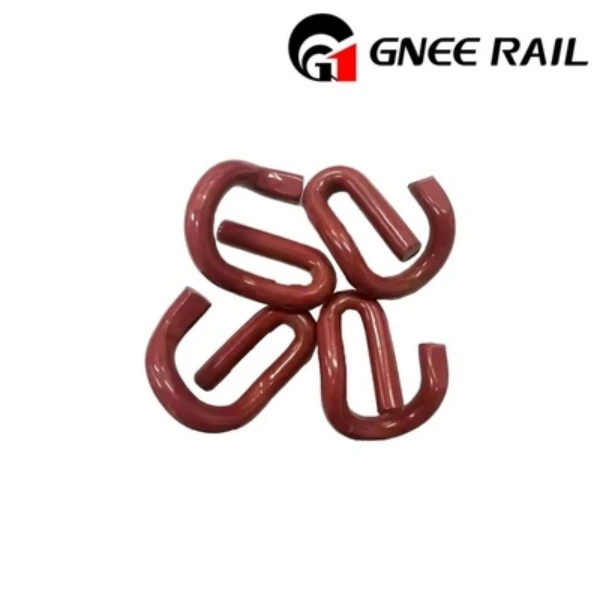
In what aspects can the structural optimization design of elastic strips reduce fatigue damage caused by vibration?
The structural optimization design of elastic strips reduces fatigue damage caused by vibration mainly from three core aspects: deformation control, stress dispersion and contact optimization, making the stress of the elastic strip more uniform under dynamic load and reducing local stress concentration. In terms of deformation control, the working deformation of the elastic strip is designed to be 60%-70% of the elastic limit to avoid a sharp increase in alternating stress caused by excessive deformation. At the same time, a gradual cross-section design is adopted to make the stress distribute evenly when the elastic strip deforms, preventing micro-cracks caused by excessive local deformation. In terms of stress dispersion, the sharp corners and bends of the elastic strip are treated with arc transition with a radius of not less than 5mm to eliminate stress concentration points. At the same time, reinforced protrusions are added at the root of the elastic strip to improve the structural strength of the root and reduce the root stress during vibration, because the root is a high-incidence area of elastic strip fatigue damage. In terms of contact optimization, the point contact between the elastic strip and the rail is changed to surface contact to increase the contact area and disperse the contact stress. At the same time, an arc fitting surface is designed at the contact part, which is precisely matched with the curved surface of the rail web to avoid additional stress caused by contact offset during vibration. In addition, optimize the position of the stress fulcrum of the elastic strip to make the force arm between the fulcrum and the force application point more reasonable, reduce the torque fluctuation during the vibration process, further reduce the amplitude of alternating stress, and reduce fatigue damage in an all-round way.

Why do the heat treatment processes of elastic strips for heavy-haul lines adopt the combination of "quenching + medium temperature tempering"?
Elastic strips for heavy-haul lines bear alternating vibration stress with large amplitude and high frequency. The combination of "quenching + medium temperature tempering" is adopted for heat treatment, which is core to make the elastic strip material obtain comprehensive properties of high hardness, high fatigue limit, good elasticity and impact toughness, accurately adapting to the harsh working conditions of heavy haul. The quenching process can transform the steel structure of the elastic strip from pearlite to martensite, greatly improving the hardness and tensile strength of the material, making the surface hardness of the elastic strip reach HRC45-50, which is enough to resist plastic deformation and wear under heavy load, and lay a structural foundation for bearing large alternating stress. Medium temperature tempering, on the basis of quenching, eliminates the internal stress generated by quenching, prevents the elastic strip from cracking in vibration due to excessive internal stress, and at the same time transforms martensite into tempered troostite. This structure has both high elasticity and good impact toughness, which can keep the performance of the elastic strip stable during repeated elastic deformation without brittle fracture. If only the quenching process is used, the elastic strip has high hardness but poor toughness, and is easy to fracture under vibration impact; if low temperature tempering is used, the internal stress elimination is insufficient, and the fatigue limit will be greatly reduced; high temperature tempering will lead to the decrease of the hardness and elasticity of the elastic strip, which cannot bear heavy load. The combination of "quenching + medium temperature tempering" can achieve a balance of performance, making the fatigue life, elasticity and toughness of the elastic strip meet the design requirements of heavy-haul lines.
How to reduce the dynamic stress under vibration load by optimizing the contact mode between the elastic strip and the rail?
The core of reducing dynamic stress by optimizing the contact mode between the elastic strip and the rail is to make the stress at the contact part uniform and avoid contact offset and additional stress, which is mainly realized from three aspects: contact form, contact area and contact positioning. In terms of contact form, the traditional point/line contact is changed to arc surface contact, the curvature of the arc surface is precisely matched with that of the rail web, and the fitting gap is ≤0.1mm. The contact position between the elastic strip and the rail will not shift during vibration, avoiding the transverse additional stress caused by the shift. At the same time, the surface contact can make the dynamic stress evenly distributed on the contact surface and reduce local stress concentration. In terms of contact area, appropriately increase the contact end area of the elastic strip, from 8-10mm to 12-15mm in width. With the increase of contact area, the dynamic contact stress borne per unit area will be reduced by 20%-30%, greatly reducing the fatigue damage at the contact part. In terms of contact positioning, design anti-off positioning protrusions at the contact end of the elastic strip, which are precisely matched with the grooves of the rail web to prevent the elastic strip from lateral movement during vibration, ensure the stability of the contact position, and avoid the sudden change of dynamic stress caused by movement. In addition, sandblasting anti-skid treatment is carried out on the contact surface to control the friction coefficient within a reasonable range of 0.20-0.25, which not only prevents slipping at the contact part, but also avoids the stress transmission loss caused by too high friction coefficient, makes the dynamic stress transmit smoothly, and further reduces the stress fluctuation caused by vibration.