


Correlation Control of Pressure Plate Installation Eccentricity and Rail Longitudinal Creep
Why does eccentric installation of pressure plates cause longitudinal rail creep?
Longitudinal rail creep stems from train traction and braking forces. Under normal conditions, symmetrically installed pressure plates generate uniform longitudinal resistance to balance these external forces. Eccentric installation shifts the contact point between the plate and rail, offsetting the longitudinal resistance application point and creating an additional moment. Under train traction, the rail rotates slightly around the eccentric resistance point, leading to longitudinal displacement. This displacement accumulates under repeated loads, eventually forming significant rail creep.

What are the two types of pressure plate installation eccentricity, and how do they differ in their impact on rail creep?
Eccentricity is divided into "longitudinal eccentricity" and "lateral eccentricity." Longitudinal eccentricity (offset along the rail length) directly increases the longitudinal slip resistance difference, accelerating unidirectional rail creep in the traction direction-common in braking sections of long downgrades. Lateral eccentricity (offset along the rail width) subjects the rail to an additional lateral moment, causing simultaneous longitudinal creep and lateral displacement, leading to gauge widening. The two types often coexist, synergistically exacerbating track geometry disorders.

Beyond what limit does longitudinal rail creep endanger line operation safety?
Limits vary significantly by line type: for conventional lines, longitudinal creep shall not exceed 15mm-exceeding this causes uneven rail gaps, risking rail buckling. High-speed lines impose stricter controls (limit = 5mm); exceeding this disrupts the locked state of ballastless continuously welded rails, causing abnormal thermal stress. Switch areas have the strictest limit (≤3mm); excess creep impairs point machine conversion accuracy, leading to switch failure.
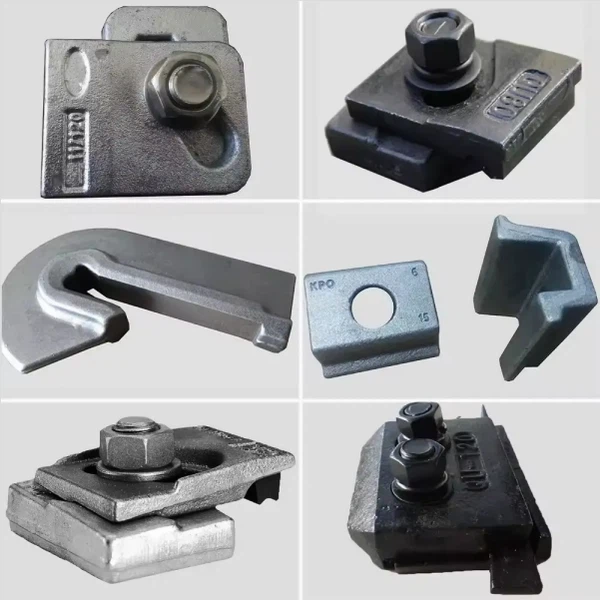
How to control pressure plate installation eccentricity on-site to avoid offset defects during construction?
Core control measures include three steps: first, standardized positioning-using the rail longitudinal centerline and sleeper centerline as dual benchmarks, fixing plate positions with special positioning templates to ensure pre-installation accuracy. Second, tool-based installation-using torque wrenches with positioning jigs to prevent plate displacement during bolt tightening. Third, standardized inspection-after installation, measuring the distance between the plate edge and rail edge with a steel ruler; bilateral deviation shall not exceed 1mm. Full-process control of "positioning-installation-inspection" effectively avoids installation eccentricity.
How to rectify existing pressure plate installation eccentricity to eliminate rail creep hazards?
For minor eccentricity (1-2mm deviation), loosen bolts, tap the plate gently with a rubber mallet for fine adjustment using a positioning template, then retighten and re-inspect. For severe eccentricity (>2mm), completely remove the plate, clean debris and rust from the contact surface, and reinstall according to benchmarks-never force correction. After rectification, monitor rail creep in the section for one week; no abnormalities confirm hazard elimination. Simultaneously, inspect plates from the same construction batch to prevent batch eccentricity defects.