


In the field of rail production, hot rolling technology occupies a pivotal position and is a key link in determining the quality and performance of rails.
Hot rolling technology principle and rail production process
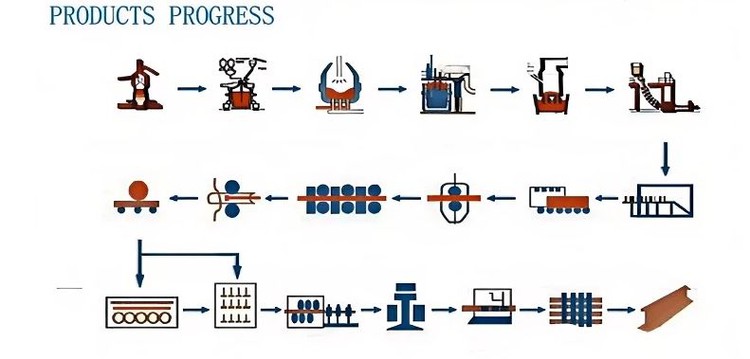
Hot rolling is to heat the billet to above the recrystallization temperature, use the strong pressure of the rolling mill to deform the billet, and finally roll it into a rail of a specific shape and size. In actual production, the billet after smelting and refining is first sent to the heating furnace and heated to about 1100-1300℃, at which time the billet is in a good plastic state. The heated billet passes through the rough rolling mill and the finishing rolling mill in turn, and is gradually formed after multiple rolling passes. During the entire rolling process, the dimensional accuracy and surface quality of the rail are ensured by adjusting the parameters such as the speed and pressure of the roller. After rolling, the rail needs to go through subsequent processes such as cooling, straightening, and flaw detection before it can become a qualified product and enter the market.

Hot rolling technology improves rail performance
Strength improvement: Through work hardening and organizational optimization during hot rolling, the strength of the rail is significantly improved. Reasonable control of rolling process parameters, such as rolling temperature, deformation, etc., can enable the rail to obtain ideal strength indicators.
Toughness improvement: The refined grain structure not only improves the strength, but also improves the toughness of the rail. The improvement in toughness enables the rail to effectively absorb energy when subjected to impact loads, reducing the risk of crack generation and expansion.
Enhanced wear resistance: The surface quality and internal organization of the rail after hot rolling have an important influence on its wear resistance. Rails with good surface finish and uniform and dense internal organization have significantly reduced wear rate during long-term friction with wheels. For heavy-duty railways, due to the large axle weight, the wear resistance of the rails is extremely high. Hot rolling technology plays a key role in improving the wear resistance of the rails, effectively extending the service life of the rails and reducing the cost of railway maintenance.
Application of hot rolling technology in different types of rails
High-speed railway rails: High-speed railways have extremely strict requirements on the accuracy, smoothness and comprehensive performance of rails. Hot rolling technology can produce rails with extremely small dimensional tolerances and excellent surface quality through high-precision rolling mill equipment and advanced automatic control systems. At the same time, the rails after optimizing the hot rolling process have high fatigue resistance and can withstand the frequent alternating loads of high-speed trains, meeting the needs of long-term and efficient operation of high-speed railways.

Heavy-duty railway rails: Heavy-duty railways are mainly used for bulk cargo transportation, with axle weights of up to 30 tons or even higher, which requires rails to have extremely high strength and wear resistance. In the production of heavy-duty railway rails, hot rolling technology uses special alloy composition design and rolling technology to produce 75kg/m special rails, which not only have high strength, but also have internal structures that can effectively resist the crushing and wear of heavy-duty wheels.
Urban rail transit rails: Urban rail transit includes subways, light rails, etc., and its operating characteristics are frequent starts and stops and small curve radius. Therefore, rails for urban rail transit need to have good fatigue resistance and anti-stripping performance. When producing such rails, hot rolling technology adjusts the rolling process to optimize the residual stress distribution inside the rails and reduce fatigue damage caused by frequent starts and stops and curved operation. At the same time, by controlling the cooling rate after hot rolling, the microstructure of the rail surface is improved, the anti-stripping performance is improved, and the safe and stable operation of urban rail transit is ensured, providing reliable protection for the daily travel of urban residents.