


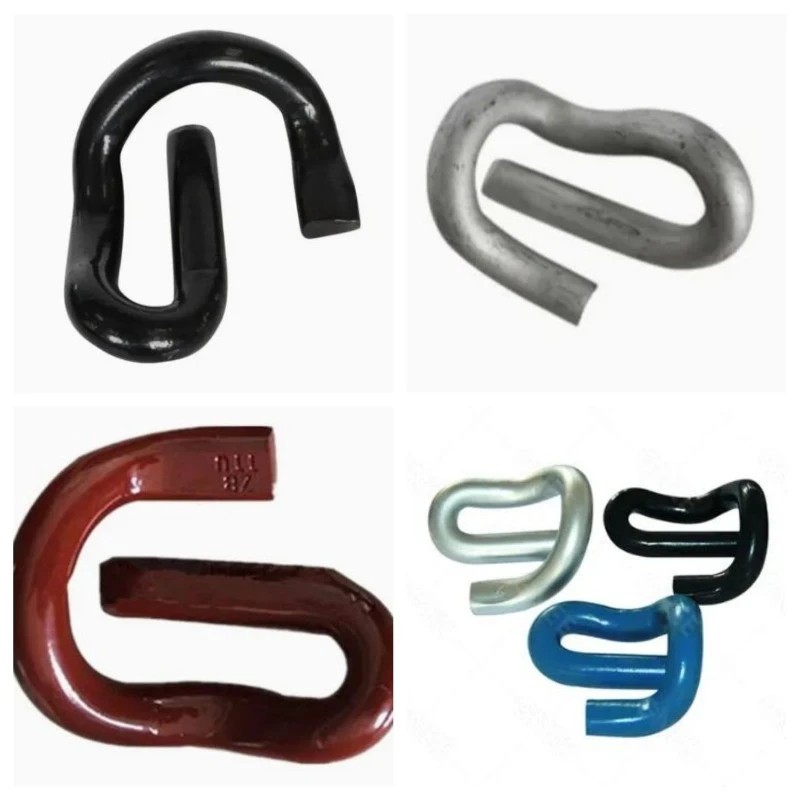
As the core component of the railway fastener system, rail spring clips play a role in clamping and tightening the rails, and play a key role in ensuring the stability of the track structure, maintaining the track gauge, and providing elastic buffering. According to different railway operation needs and track structure characteristics, rail spring clips have derived various types.
Spring clip type Ⅰ
Spring clip type Ⅰ consists of ω-shaped spring clips, spiral spikes, track gauge baffles, baffle seats and elastic rubber pads. This type of spring clip is relatively simple in design and has a certain degree of elasticity. It can maintain the geometric shape of the track to a certain extent and is widely used in early ordinary railway lines. However, it has the defects of insufficient buckling pressure and small elastic range, and the safety strength reserve of the spring clip design is poor, which is difficult to meet the current heavy-load transportation needs. When facing the operation of large-volume and heavy-axle-loaded trains, it is easy to loosen and deform, affecting the stability of the track.

Elastic Clip Type II
Elastic Clip Type II is similar to Elastic Clip Type I in structure, the main difference is that the material of the elastic clip is upgraded to 60Si2CrVA. This material optimization significantly increases the buckle pressure of the elastic clip, with higher strength safety reserve and smaller residual deformation. It is suitable for 60kg/m rail lines with Type II or Type III concrete sleepers, and is widely used in ordinary railways and specific sections of some heavy-duty railways. However, the anti-rust and anti-loosening work of the elastic clip type II is more complicated, requiring regular maintenance, and it is difficult to meet the requirements of high reliability and high stability of rail fasteners in high-speed operation scenarios.
Elastic Clip Type III
Elastic Clip Type III is a boltless and shoulder-free fastener, consisting of an e-shaped elastic clip, an embedded iron seat, an insulating gauge block, and a rubber pad. It has strong buckle pressure, excellent elasticity, excellent gauge holding ability, and less maintenance work, representing the development trend of boltless and shoulder-free fasteners. In some areas with high requirements for track stability and limited maintenance operations, such as underground lines of urban rail transit and long tunnels, the advantages of spring clip type III fasteners are obvious. However, its disadvantage is that it does not have the height adjustment function. On small radius curves, the gauge block is easily damaged due to concentrated force, and after repeated use, the buckling pressure of the spring clip will be reduced.
Spring clip type IV
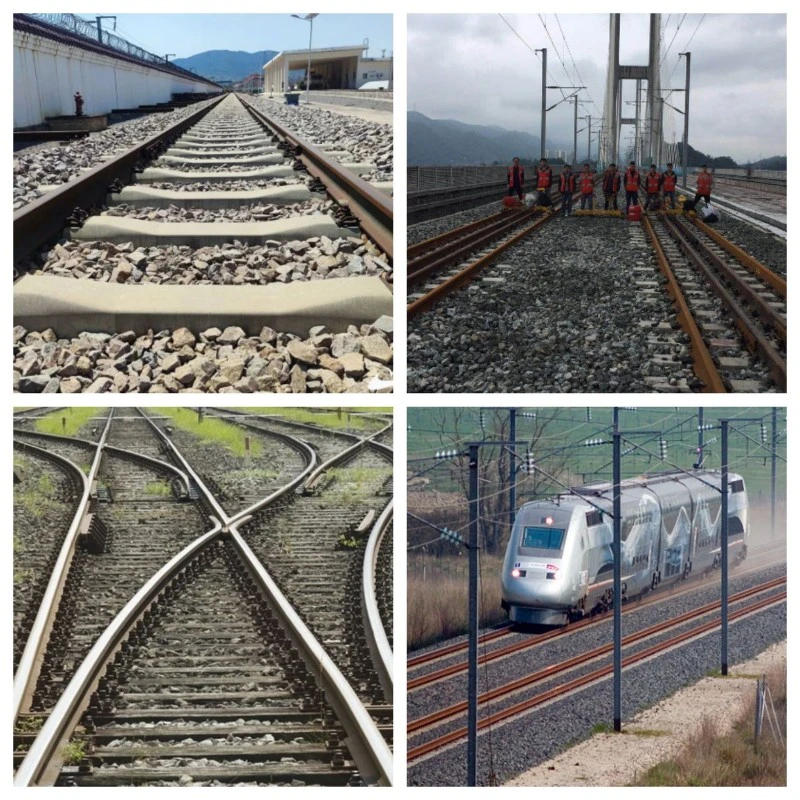
Spring clip type IV is specially designed for high-speed ballasted tracks and optimizes the spring clip structure. While maintaining good elasticity, it can adjust the track gauge more accurately and adapt to the high-frequency vibration and strong impact force generated by high-speed trains. It effectively guarantees the smoothness and stability of the track, thereby providing solid support for the safe, smooth and comfortable operation of high-speed trains. It is one of the commonly used spring clip types in high-speed ballasted track lines.
Spring clip type V
Spring clip type V is improved based on spring clip type II, increasing the spring clip range and buckling pressure, further improving the fastening performance and fatigue resistance of the fastener system, and is also suitable for high-speed ballasted tracks. Compared with Type IV spring clip, Type V spring clip inherits some of the mature designs of Type II spring clip and is enhanced to meet the needs of high-speed operation, thus providing additional protection for the reliable operation of high-speed ballasted track.